

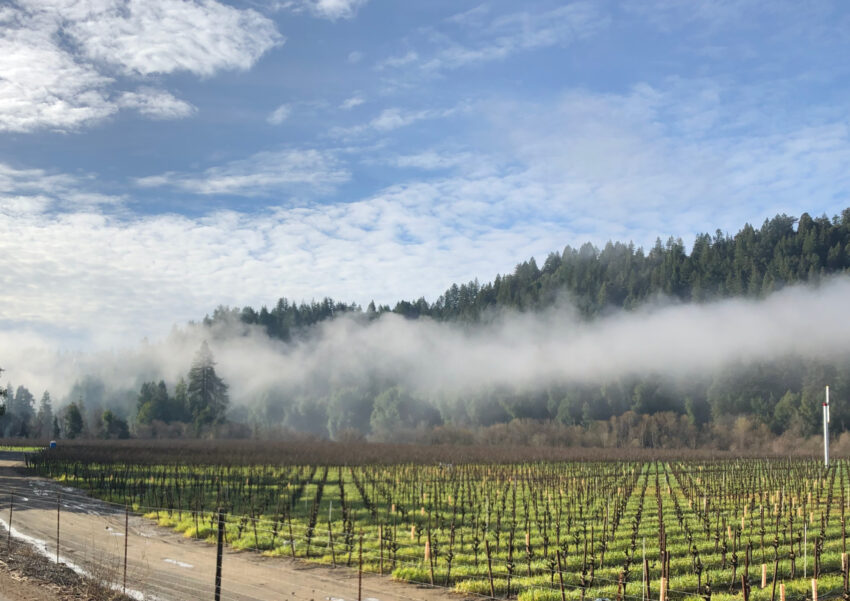
A Sonoma County farmer who’s been growing vegetables on a hillside parcel for five years and now wants to plant wine grapes faces a bureaucratic wall: under current rules, that swap counts as new vineyard development, triggering the same permit process required for breaking raw ground.
A proposed change to county law, circulated Tuesday, would fix that.
The county’s Agriculture Department is asking the Board of Supervisors to amend the Vineyard Erosion and Sediment Control Ordinance — VESCO — to let farmers who have worked a parcel for at least five years switch to grapes or orchard crops under the lighter “replanting” permit pathway rather than the heavier “new development” track.
The county doesn’t regulate what farmers grow. It regulates what they do to the land to grow it.
Planting a vineyard means moving a lot of dirt. Growers grade slopes, cut roads, install drainage pipes and terrace hillsides. All that earthmoving can send soil into streams. Sonoma County’s streams are home to coho salmon, listed as endangered under federal law, and steelhead, listed as threatened. VESCO requires farmers to submit erosion control plans before making those changes.
Under current rules, growers converting cultivated fields — land already being farmed — to vineyards or orchards must go through the new development process but get a pass on one step: a biotic resource assessment, which checks for sensitive plant and animal species.
The proposed amendment would move those conversions onto the replanting track, which carries its own, generally lighter standards. The tradeoff: conversions in areas the federal government has designated as critical habitat would now require a focused species assessment — a check not currently demanded of cultivated-land conversions.
“Because crop conversions would instead be regulated under the provisions for replanting permits,” the Agriculture Department wrote in the memo, “the permit requirements for new vineyard and orchard development would revert back to the prior ordinance language before the cultivated lands exemption was introduced.”
The proposal grew out of an April 14 workshop held by the Board of Supervisors’ Agriculture Ad Hoc Committee. Growers, industry groups and members of the public testified that farms needed more flexibility to rotate and change crops. The committee directed staff to develop a multi-year workplan.
On June 2, the committee brought that workplan to the full board, with the VESCO amendments listed as an early action item.
The proposal would also put on paper an extension option the Board approved in 2021 but never wrote into the ordinance. Replanting permits currently run five years. The new language would let farmers request one additional five-year extension before a permit expires — 10 years total to finish a conversion.
No board hearing date has been set.
The proposal was prepared by the Agriculture Department under Commissioner Andrew F. Smith.