

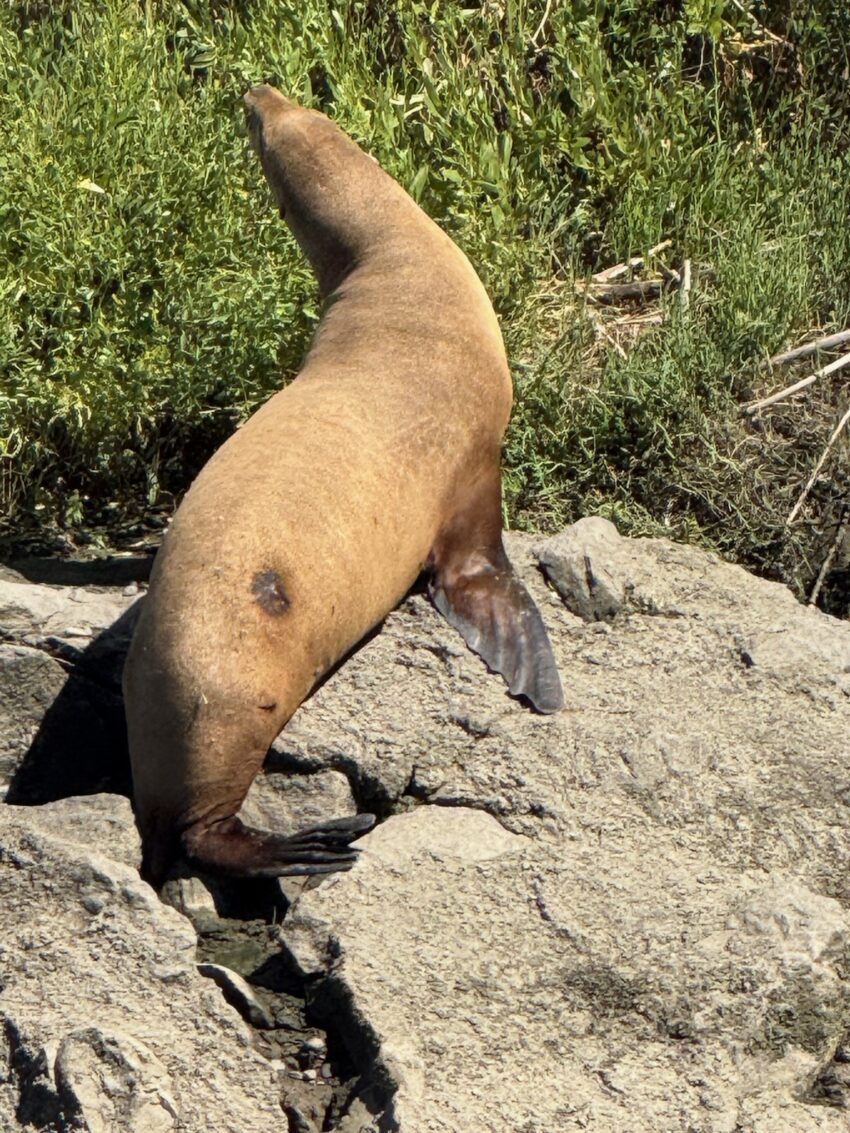
A California sea lion that turned up along the Petaluma River last week was rescued Monday and later euthanized, after wildlife veterinarians found signs of a marine neurotoxin that attacks the brain, The Marine Mammal Center said.
The Sausalito-based center pulled the roughly 170-pound adult female off a dock across from the Petaluma Yacht Club on the afternoon of Monday, June 29, after tracking her along the river since Friday. At the center’s hospital, veterinarians found her disoriented and behaving in a way consistent with domoic acid toxicosis. Given the poor prognosis, the team euthanized her.
Responders named her Heenalu, after “Nalu,” the Hawaiian word for wave.
Key Takeaways
- A sea lion rescued from the Petaluma River on June 29 was euthanized after showing signs of domoic acid poisoning. A necropsy is planned to confirm the diagnosis.
- The Marine Mammal Center says there is no active domoic acid outbreak in the region this year, with roughly two dozen suspected cases coastwide.
- It is the second Petaluma sea lion in two summers put down over the toxin. Last year’s animal, logged as “Catfish,” was confirmed to have it.
- The center asks the public to stay at least 150 feet from marine mammals and call its hotline, 415-289-SEAL, rather than step in.
Since Friday on the river
The center’s dispatch office took its first calls around 8:30 a.m. Friday, June 26, reporting a sea lion hauled out near the Lynch Creek Trail along the Petaluma River. Trained volunteer responders headed out and met up with partners from Sonoma County Wildlife Rescue.
Responders first sized the animal up as a subadult in good body condition, with no obvious injuries, and watched her for several hours. A fast-rising tide made a safe capture impossible, and before the team could act she slipped back into the river and swam off on her own.
She turned up again Monday morning, this time on a dock farther south, across from the Petaluma Yacht Club. Responders confirmed it was the same animal and made the rescue that afternoon, then drove her to the center’s hospital in Sausalito. The admission exam identified her as a nearly 170-pound adult female and turned up the neurological signs that pointed to domoic acid. A necropsy is planned to confirm the diagnosis and check for any other underlying illness.
What domoic acid does
Domoic acid is a neurotoxin produced by blooms of microscopic algae. It builds up in the anchovies and sardines that sea lions eat and works its way into the animals, where it can cause disorientation, seizures and death. From the outside, a poisoned sea lion can look fine. The center says conditions like domoic acid toxicosis, or the bacterial disease leptospirosis, cannot be diagnosed by sight and require a full exam at its hospital.
It is not unusual to see sea lions or harbor seals push up the Petaluma River from San Francisco Bay, often chasing a meal. What is harder to see is what is wrong with them.
Despite two Petaluma cases in two years, the center says this is not a return of the large toxic blooms of recent years. There are no active outbreaks of either disease impacting marine mammals in the region right now, the center said, estimating about two dozen suspected domoic acid cases in sea lions along the coast so far this year. Of the roughly 350 to 360 animals the center has rescued in 2026 across its 600-mile stretch of California coast, more than 200 have been California sea lions.
An echo of last summer
Petaluma has been here before. Last July, a sea lion that hauled out near the Petaluma Premium Outlets drew a following online, where locals called it “Mallory” and “Stevie” before it was rescued. The center logged it as “Catfish.” That animal was also euthanized, after a string of neurological episodes that included tremors and a seizure, and a necropsy confirmed domoic acid toxicosis.
If you see one
The Marine Mammal Center asks people to give marine mammals room — at least 150 feet, or 50 yards — and to keep dogs leashed. Use the zoom to take photos rather than moving closer; if the animal reacts to you, you are too close. Anyone who spots a marine mammal in distress should call the center’s hotline at 415-289-SEAL (7325) rather than try to help the animal themselves.
Frequently Asked Questions
What happened to the sea lion in the Petaluma River?
It was rescued from a dock near the Petaluma Yacht Club on June 29 and taken to The Marine Mammal Center’s hospital in Sausalito, where veterinarians euthanized it after finding signs of suspected domoic acid poisoning. A necropsy is planned.
What is domoic acid?
It is a neurotoxin made by blooms of marine algae that builds up in fish such as anchovies and sardines. Sea lions that eat contaminated fish can suffer disorientation, seizures and death.
Is there a domoic acid outbreak in the North Bay right now?
No. The Marine Mammal Center says there is no active outbreak in the region, with roughly two dozen suspected cases along the California coast so far this year.
What should I do if I see a stranded sea lion?
Keep at least 150 feet away, keep dogs leashed, and call The Marine Mammal Center’s hotline at 415-289-SEAL (7325). Do not try to help the animal yourself.