

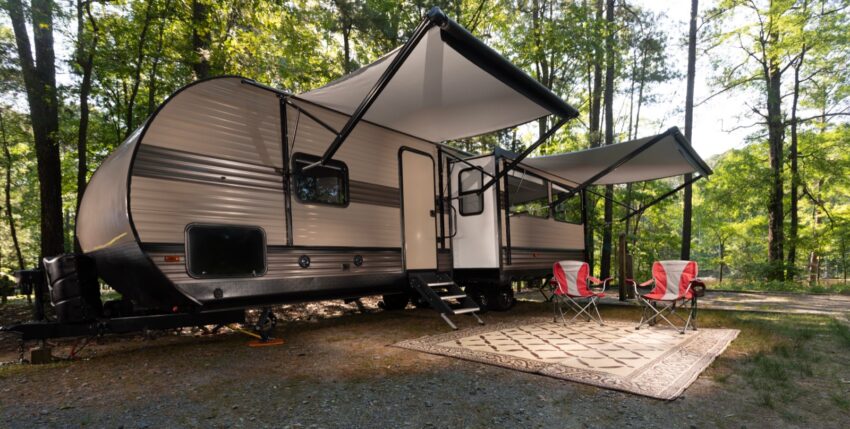
A 4-year-old girl died Sunday at a Salt Point State Park campground, pinned beneath a motorhome that moved backward as she stood behind it.
The California Highway Patrol responded to a report of a child trapped under a motorhome just after 11 a.m. on July 12. Firefighters from several agencies jacked the motorhome up to get her out. She was flown to a children’s hospital in Oakland with major injuries and pronounced dead that afternoon.
The driver was a family friend, according to the CHP. He was easing the motorhome forward to leave, the agency said, but the transmission was in reverse rather than drive, and the vehicle rolled back into the girl. Her name has not been released. No charges have been announced.
The state does have a rule for what the CHP describes. It’s a traffic infraction.
The rule comes from the Vehicle Code, not the park rulebook
Two provisions of the state code bear directly on this. Section 4350 of Title 14 says the Vehicle Code applies inside park units the way it applies on a highway. Section 4353 sets the speed ceiling: “In no event shall a vehicle be driven at a speed greater than 15 miles per hour in camps, picnic areas, utility areas, or headquarters areas or in areas where the general public assembles.”
Speed isn’t what happened here. By the CHP’s own account, the driver was moving slowly.
The provision that fits comes from the Vehicle Code, and it reaches into the campground through Section 4350. Vehicle Code Section 22106 covers unsafe starting and backing: “No person shall start a vehicle stopped, standing, or parked on a highway, nor shall any person back a vehicle on a highway until such movement can be made with reasonable safety.”
That’s the rule. Whether a driver can back up “with reasonable safety” gets decided on the facts of the case. A violation is an infraction — the same class of citation the state uses for unsafe backing anywhere else in California.
So the question isn’t whether California has a law for this. It does. The question is what that law is worth on a Sunday morning at a campground, and whether the CHP will write it.
What is still unanswered
Whether the driver will be cited under the backing statute is a question for the CHP.
Salt Point runs two campgrounds, Gerstle Cove and Woodside, at $35 a night, in California State Parks’ Sonoma-Mendocino Coast District. The park allows motorhomes up to 36 feet and trailers up to 31 — big rigs, backing into wooded sites, on the same ground where families are camped.
Then there are the questions only State Parks can answer. Whether the department counts vehicle strikes in its campgrounds. Whether rangers at Salt Point or anywhere else have ever flagged vehicle movement through occupied sites as a hazard. Whether any of it has prompted a change to how a campground loop is laid out, or how a driver is told to leave one.
The Gazette has put those questions to State Parks and filed a public records request for a decade of campground vehicle-strike records, the department’s rules on how vehicles move through occupied sites, and any hazard warning its own rangers have raised. It has also asked the CHP whether the driver will be cited.
What the rule doesn’t decide
An infraction is a fine. It’s a box checked on a citation, and it doesn’t measure anything about Sunday morning.
The driver wasn’t a stranger. He was a friend of the family, doing the most ordinary thing a person does at the end of a camping trip — putting the vehicle in gear to go home. The gear was wrong. That’s the whole of it, and no traffic code has a line for what that costs him, or the girl’s parents, for the rest of their lives.
What the code can do is govern the next 36-foot motorhome backing out of a site while somebody’s kid stands where the mirrors don’t reach. Right now, all the state brings to that is a citation for unsafe backing.
This story will be updated as the CHP and State Parks respond.