

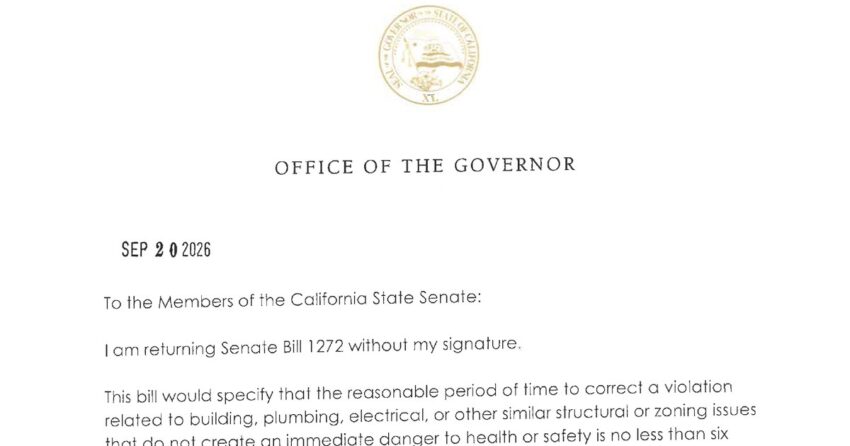
Gov. Gavin Newsom vetoed a bill Sept. 20 that would have given new homeowners time to fix code violations left behind by the people who sold them the house. His reason: local officials should keep discretion over code enforcement.
Nine days later, Napa County staff showed supervisors what a local version could look like. Then they said they weren’t bringing it forward.
The Board of Supervisors took up the issue Tuesday during the Code Compliance Division’s annual update. Supervisors supported continued education and outreach, so prospective buyers understand a property’s permit and compliance history before they buy, according to the county’s summary of the meeting.
Who pays
New owners can unknowingly buy a property with existing violations. They’re responsible for the full compliance fees, according to the division’s presentation.
In June 2025, supervisors asked staff to look into options for those buyers.
The staff report for Tuesday’s meeting, by Code Compliance Manager Akenya Robinson-Webb, recommended better education for buyers and continued monitoring of a pending state bill, SB 1272, “rather than developing a separate County program at this time.”
The education approach, the report said, “does not eliminate the possibility that an innocent buyer may encounter an existing violation after a purchase.”
The bill
SB 1272, by Sen. Caroline Menjivar, D-San Fernando Valley, covered owner-occupied homes with four units or fewer. An owner who swore they didn’t cause a violation, and didn’t know about it when they took title, would have gotten at least six months to fix it. Show a good-faith effort, and they’d get six more.
It passed the Senate 35-1 in May. It passed the Assembly 67-3 in August.
Newsom vetoed it Sept. 20.
“I am sympathetic to the author’s goal of giving new property owners ample time to fix problems undisclosed by the sellers,” he wrote in his veto message. “However, local officials should retain discretion in how they carry out code enforcement.” The bill, he said, would “tie their hands with a one-size-fits-all approach.”
The Napa version
The presentation supervisors saw Tuesday reflected the veto. With the issue unresolved by state law, it said, “any near-term solution is again a local decision.”
So staff sketched one. They called it an Innocent Buyer Program, modeled in part on Sonoma County’s Innocent Purchaser exclusion.
To qualify, an owner would have to have bought within the past 12 months. The violation couldn’t have been disclosed on the seller’s transfer disclosure statement, and the owner couldn’t have known about it. The owner would have to enroll within 90 days.
In return: reduced investigation fees, priority permit review, and no escalation of citations while the owner stays on track.
“Proposal only,” the slide said. The concept “is not being brought forward for adoption.”
Sonoma County’s code already has an innocent purchaser exclusion. An owner there who can show the violation existed when they bought, and that they had no actual or constructive notice of it, may be excluded from civil penalties if they start fixing it within 30 days, according to Permit Sonoma.
The rest of the update
The division closed 365 cases in the 2025-26 fiscal year and opened 303. It was the first year since the COVID-19 pandemic that closures outnumbered new cases, the county said.
Its work on unpermitted construction turned up $4.95 million in construction value and $576,552 in code investigation fees, according to the staff report.
And on Dec. 9, 2025, supervisors replaced a rule that allowed up to 100 roosters per parcel with a tiered limit based on parcel size, the report said.
The staff report, written while the bill was still pending, left one door open. If SB 1272 didn’t advance, it said, “staff can return with potential local options for consideration.”