

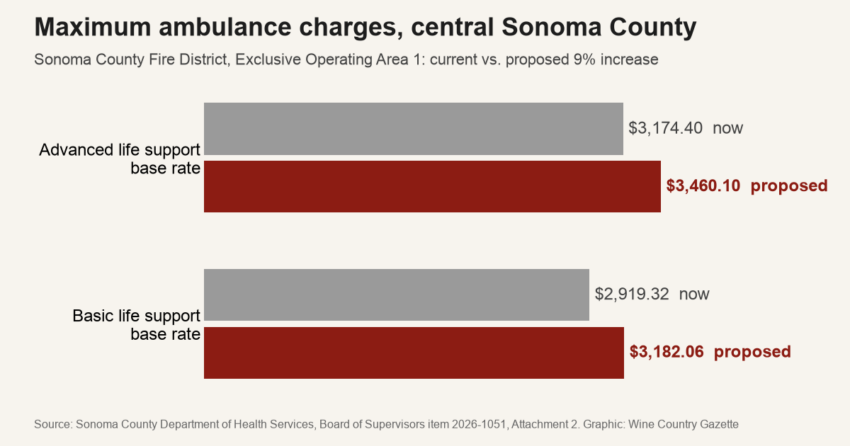
SANTA ROSA, 10/12/26 — The most Sonoma County Fire District can charge for an ambulance ride in central Sonoma County would go up 9% under an item on the Board of Supervisors’ consent calendar Tuesday.
The district asked for 16.36% in July. The county Department of Health Services, or DHS, recommended 9%, inclusive of any cost-of-living adjustment. It said that was the most it was prepared to recommend on the record it has.
Under the new schedule, the base rate for an advanced life support transport would go from $3,174.40 to $3,460.10. A basic life support transport would go from $2,919.32 to $3,182.06. Mileage would go from $71.68 to $78.13 a mile. There’s also a new standby charge for special events: $270.64 an hour for an advanced life support ambulance.
Those are ceilings. The county’s staff report, which calls the district SCFD, says the maximum charges “do not necessarily equal the amount SCFD will collect or the amount an individual patient will be required to pay.”
The district is the exclusive emergency ambulance provider in what the county calls Exclusive Operating Area 1. It runs from Penngrove to Larkfield and from Occidental to Kenwood, and takes in Santa Rosa, Rohnert Park, Sebastopol and Cotati, along with Kenwood, Larkfield, Oakmont, Graton, Occidental and Mark West Springs. The county picked the district through a competitive process in 2023. Service began on Jan. 16, 2024.
The board meets at 9 a.m. at 575 Administration Drive in Santa Rosa, and the consent calendar is set for 10 a.m. Consent items are usually approved together in a single vote, with no discussion unless a supervisor asks to pull one.
Who pays the higher rate
Most of the district’s patients are on Medicare or Medi-Cal. In its July request, the district put Medicare at 52.8% of patients and Medi-Cal at 27.3%. Commercial insurance was 13.7%. Private pay was 6.2%.
Government payers pay set amounts. The district’s billing company, Wittman Enterprises, wrote in a letter attached to the request that those “payment amounts are predetermined and are not affected” by the rates a provider sets.
The county estimates that fewer than 14% of the district’s transports involve patients with state-regulated commercial coverage, where the new schedule may change what the plan pays.
State law generally bars a ground ambulance provider from charging an uninsured or self-pay patient more than the greater of the Medicare or Medi-Cal fee-for-service amount. Patients in state-regulated health plans who ride with an out-of-network ambulance generally can’t be charged more out of pocket than they’d owe an in-network provider. Other coverage, such as self-funded employer health plans, follows different rules and may not carry that protection, the staff report says.
The district said it collects about 26 cents of every dollar it bills, and about 5 cents on the dollar from private-pay patients. That’s why, it said, it needed a 16.36% rate increase to bring in about 6% more revenue.
Why the district asked for 16.36%
Fire Chief Ronald L. Busch’s July 2 letter projected a $2,457,096 shortfall for the 2026-27 fiscal year: $42,656,363 in expenses against $40,199,267 in revenue.
Pay may be the biggest piece, by Busch’s account. After the previous provider lost the contract, he wrote, it gave its employees a raise that the district “had to match- without the ability to raise our transport rates.” He called that “perhaps, the largest component in our ultimate Shortfall.”
The letter also cites dispatch costs. REDCOM, the emergency medical dispatch system, became a joint powers authority in October 2024, and the district pays about 33% of its budget. REDCOM has told member agencies to expect a 4% increase in dispatch fees for 2026-27. The district also wants to start repaying its enterprise fund and building a reserve.
The letter says the district reaches patients within the contract’s time standards 97% of the time, against the 90% the contract requires.
Why the county said 9%
In an Aug. 31 letter to Busch, Health Services Director Nolan Sullivan wrote that the department “recognizes SCFD’s strong operational performance” but was “not prepared to recommend” 16.36%.
The staff report describes “strong returns in the initial period of operations but flat revenues and accelerating expenditures in the last few years.” Revenue was $40,091,666 in 2024-25 and $37,935,271 in 2025-26. Expenses were $30,255,466 and $33,398,488.
For 2026-27, the staff report’s table starts from the same $40,199,267 in revenue the district projected. It puts expenses at $40,297,287. That’s a loss of $98,020, before the 9% increase.
By the end of this fiscal year, the county projects the district’s ambulance fund will hold about $11.6 million. That includes about $3.5 million in reserves toward the district’s $6 million target and about $9.5 million unrestricted. The $5.7 million the ambulance operation owed the fire district for its startup would be paid off by the end of this year.
The department “is confident that a 9% increase provides sufficient financial cushion for the remainder of this fiscal year, particularly in light of SCFD’s indicated cash balances,” the staff report says.
The audit
The district agreed to cooperate with an independent financial audit. The 9% increase would take effect when the board approves it. It doesn’t wait on the audit.
Under the contract, the board has to approve any increase of 10% or more. The health services director decides smaller ones. On Tuesday, the board would also direct the department to bring any future request above the annual inflation adjustment to supervisors, with the finished audit, before the director decides it.
Busch had first asked the county to approve 9.9% “ASAP,” with the rest of the increase and a cost-of-living adjustment in January 2027, according to a July 3 email The Press Democrat reported July 18. The paper’s editorial board wrote July 25 that the district wanted to avoid an audit, called the split “an accounting gimmick” and said supervisors should “demand a thorough public vetting.”
The fire district’s own board has already acted. At a special meeting Aug. 25, it adopted an ordinance amending the district’s emergency medical service fees. Busch told the board the increase should change from 9.9% to 9%, contingent on county approval, according to the minutes. That was six days before Sullivan’s letter recommending 9%.
Supervisors last raised the district’s rates on Sept. 9, 2025, by 2.4%.
Sullivan’s letter says the department won’t consider another increase before January 2027. “Nothing in this letter represents that SCFD will be eligible for an additional adjustment in January 2027 or that DHS or the County will approve or recommend any future request,” he wrote.