

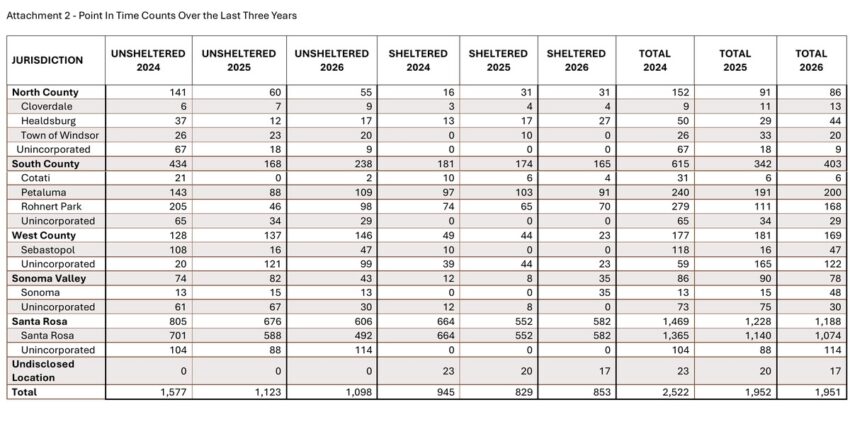
Sonoma County counted 1,951 people experiencing homelessness this year, one fewer than in 2025, but county health officials told supervisors Tuesday that the steady number hides growing trouble.
The count ended five to seven years of back-to-back declines, Department of Health Services Director Nolan Sullivan told the board. He said federal COVID relief money is gone, Measure O homelessness money is essentially spent and the county doesn’t plan another round of grants from it. He warned the county would be in trouble if it didn’t act soon.
Sullivan said the people still homeless are older and more medically fragile. The county’s report on the count, held Jan. 30, says they are homeless for longer periods and face higher vulnerability.
Who was counted
Of the 1,951 people counted, 1,098 were unsheltered, down 2% from last year, and 853 were in shelters or transitional housing, up 3%, the report says.
The number of chronically homeless people, who have been homeless at least a year and have a disability, rose from 730 to 818. Young adults ages 18 to 24 and unaccompanied children rose from 123 to 168. The report ties that increase to the closure of Social Advocates for Youth, which ran the county’s only youth shelter.
Homeless families fell from 78 to 42. The report credits the county’s Keep People Housed prevention program, which it says has served 394 households in two years. Homeless veterans rose from 99 to 104.
In West County, the count fell from 181 to 169. Unincorporated West County dropped from 165 to 122, while Sebastopol rose from 16 to 47.
A second list runs higher
Hunter Scott, the department’s deputy director for homelessness, told the board the county also keeps a by-name list of people experiencing homelessness. That list held 2,166 people on the day of the count and 2,390 now, he said, though he cautioned that the county is not yet fully confident in its numbers.
Scott said providers took 17% cuts in their county contracts last year, and that federal cuts to the Continuum of Care program could cost the county about 100 more housing units. The count is required to keep about $4.6 million a year in federal Continuum of Care funding, according to the staff report.
The report was informational, and the board took no action.
Bus routes to change in February
Supervisors also held a required public hearing on changes to 14 Sonoma County Transit routes, planned with Santa Rosa CityBus and Petaluma Transit to take effect Feb. 14, 2027. The board didn’t vote. Staff said Santa Rosa takes the plan up Nov. 17.
Under the proposal, Route 20 from West County and Route 30 from Sonoma Valley would end at the Santa Rosa Transit Mall, where riders would transfer to Santa Rosa CityBus. The existing Route 20X would be replaced by more 20X service between Sebastopol and Santa Rosa. Route 28 would add Armstrong Redwoods State Natural Reserve. Route 62 between Santa Rosa and Windsor would be eliminated, and Routes 44 and 48 would merge.
Operating costs are growing faster than revenue, and Sonoma County Transit is drawing on reserves this year, the staff report says. It puts the savings from the changes at $288,301 this fiscal year and $768,804 next year. No fare changes are proposed.
Mark McMullen, a Healdsburg rider, asked the board to hold off on removing stops from Route 67 in Healdsburg until riders and the city review them. Vice Chair Chris Coursey praised the agencies for sharing resources instead of cutting service.
Other actions
On a 5-0 vote on the consent calendar, the board approved a grant agreement of up to $1.5 million over two years with Vital Immigrant Defense Advocacy and Services for legal, mental health and other services for immigrants. Speakers, several of them in Spanish, lined up to support it.
The board also voted 5-0 to adopt the county’s Active Transportation Plan for walking and biking in unincorporated areas, replacing the 2010 Bicycle and Pedestrian Plan.