

Licensed cannabis farms in unincorporated Lake County will pay about twice this year’s tax on plants they put in the ground in January unless supervisors act in the next few weeks.
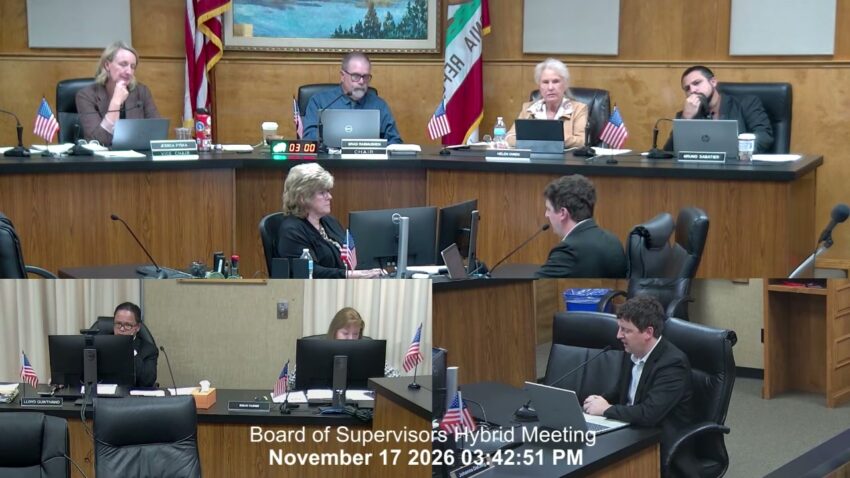
The county has charged growers half the voter-approved rate since the 2021 tax year. That cut runs out at the end of this year. On Nov. 17, the Board of Supervisors talked it over for about an hour and took no vote. The supervisors who spoke didn’t agree on what should replace it.
“Any plants that go in the ground for cannabis cultivators in January will be taxed at the full rate, according to the ordinance,” Treasurer-Tax Collector Patrick Sullivan told the board.
Sullivan estimated the full outdoor rate at about $1.06 for each square foot of plant canopy. Growers now pay about half that. The voter-approved tax from 2016 set $1 a square foot for outdoor farms, $2 for “mixed-light” farms, which can use artificial light, and $3 for indoor grows, with yearly inflation increases. For 2025 and 2026, the board has suspended those increases.
Where the supervisors stand
Vice Chair Jessica Pyska said she could live with another year at half price. “I’m okay with bringing back the 50% reduction to continue,” she said. She pointed out that wine grapes carry no such tax. “It’s the only commodity that has this tax,” she said.
Supervisor Helen Owen wants growers to pay more. She said the wine industry has also taken a hit, and “we are not giving them a 50% discount.” Citing the county’s money problems, she said “it’s irresponsible for us to leave it at the 50% reduction.” She didn’t settle on a number.
Supervisor Bruno Sabatier wants the rate tied to what growers get for their crop. Using round numbers, he said a pound that sold for $1,000 when the tax began now sells for about $250. The tax per square foot, he said, hasn’t moved with it. “To go to 100% is crazy,” he said. He asked staff for state price data and suggested a ratio that would move with prices, with “no less than 50% reduction.” He also suggested that growers who are out of compliance with county rules lose the cut.
Chair Brad Rasmussen said he was interested in a percentage, which “seems like a more fair way to do it.”
“We also thought we would probably make seven to eight million dollars a year in taxes,” Sabatier said. “We’re nowhere close.”
The county’s revenue table shows it. Cannabis taxes brought in about $8.3 million in fiscal 2020-21 and about $3.5 million in 2024-25.
The hoop house question
Sullivan also brought up farms that cover their plants in temporary plastic hoop houses. Those farms are taxed as outdoor farms, even though, he said, the cover lets them grow more crops a year. He said some people inside and outside the industry call that unfair, and one option is to deny the cut to hoop-house growers. That would put them at about $1 a square foot, he said, the same as a mixed-light farm with the cut.
A deputy director of the county’s Community Development Department said her team has reported some growers “likely getting two, three or four cycles in one season.” She said the department isn’t staffed to inspect farms more than once a year.
Pyska wasn’t sold. She said she drives past a farm on Bottle Rock Road every day where half the crop is in a hoop house and half is outside, and the two look the same. “I wouldn’t want to overtax somebody just because they’ve invested in a hoop house,” she said.
What the board can and can’t do
County Counsel Lloyd Guintivano said the board can change the tax by resolution as long as the change “does not increase the amount of tax or broaden the scope of the tax.” If a change goes further than that, he said, it may require changing the ordinance, which voters approved.
Sullivan also said the county’s cannabis equity grant money, which once helped some growers pay their tax bills, is gone; unspent money went back to the state.
What growers and neighbors told the board
Sam Edwards, a cannabis permit holder who spoke by Zoom, said Sonoma County charges 32 cents a square foot and San Benito County 25 cents, and he asked the board to keep the reduced rate for one more year.
Margaux Kambara spoke in the room. She said the county is “scraping for nickels and dimes in the sofa cushions to fund a dispatcher” while it considers renewing a tax cut. A budget update on the same agenda proposed a dispatcher position paid for with cannabis money.
Elizabeth Lincoln, speaking for a group of local license holders, asked the board to end the county’s 4% tax on equity-licensed shops.
What comes next
Owen asked to bring the item back Dec. 8, leaving Dec. 15 as a backup; Sullivan said his office would try, though that week falls in property tax season, one of its busiest times. The board also asked for a survey of what other counties charge.
Any cut has to be approved by resolution in December.
Get the Gazette by email
The day’s stories from Sonoma, Napa, Lake and Mendocino counties, picked by the editor. Free.