

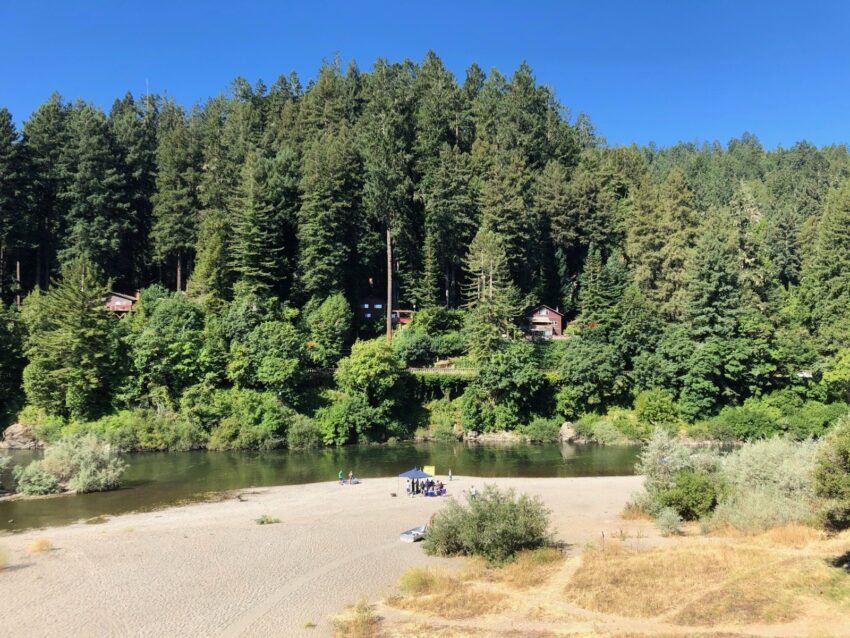
About 7,500 people in 12 west county neighborhoods rely on septic systems, from Monte Rio and Villa Grande to Camp Meeker, Hacienda and the River Road stretch north of Forestville. Sonoma Water now has a price for putting them on a sewer: $626 million, according to the agency’s final report on the plan, dated Oct. 28.
That’s most of the $716 million the study’s two-plant option would cost to build. The rest goes to fixing and combining the sewer systems that already serve Guerneville, Forestville, Graton and Occidental. The report says the version Sonoma Water now prefers would cost less to build, but it doesn’t give a new total.
Per home, the report gives $142,886. The engineering study it rests on averages about $200,000 for each equivalent home, a unit that counts a duplex or a business as more than one.
Where the 12 areas are
Engineers at West Yost, the firm that wrote the study behind the report, drew the areas around groups of at least 50 parcels where a septic system is likelier to fail or foul a creek, and where a sewer line would be easier to reach. The study says the list doesn’t decide who joins. It counts 2,930 parcels in all:
- Monte Rio and Villa Grande, 780
- River Road north of Forestville, 450
- Hacienda and Hollydale, 440
- Camp Meeker, 370
- Northwood, 190
- Forestville parcels inside the water district with no sewer, 170
- Highway 116 between Forestville and Graton, 140
- Highway 116 east of Guerneville, 110
- Summerhome Park Road, 100
- West of Graton, 70
- Guerneville north of the river, 60
- Guerneville south of the river, 50
Price per home
The October report says the $626 million “could result in costs of $142,886 per home/parcel.”
That number matches one a member of the project’s stakeholder committee worked out in comments on the draft. Rich Holmer took the report’s 7,500 people and assumed 1.7 people per home. That gave him 4,412 homes, and he wrote that the cost “would appear to be about $142,886 per home.” Divided out, $626 million over 4,412 homes is $141,886. “These costs should be clearly defined on a per parcel basis to provide transparency for people who read the report,” Holmer wrote. Sonoma Water’s answer pointed him to Page 11, where the $142,886 figure appears in the final report.
West Yost’s cost chapter does its own math. It counts 3,151 “equivalent single-family dwellings,” the unit sewer bills use. Under the option the $626 million comes from, its average comes to $200,000 for each. By area it runs from $153,000 in Monte Rio and Villa Grande to $269,000 on Summerhome Park Road. Any one house, the study says, could cost 50% to 100% more than its area’s average, or half as much.
Who would pay
Not the homeowner alone, the report says. It says there is “no expectation that homeowners would bear the entire cost of septic to sewer conversion, or that connection will be required.”
State grants could carry most of it. For communities the state counts as disadvantaged, the State Water Board caps its help at $175,000 for each home. The report says that’s likely to cover most conversions, and the study area includes some disadvantaged communities along the lower Russian River. Owners can’t apply on their own, though. The money goes to a district or other public agency.
Sonoma Water’s answer to one comment says a regional system “will not move forward without significant state funding/grants for capital improvements.”
Then there’s the cost of running it. The study puts that at about $2,100 a year for each equivalent home in areas sent to Guerneville’s plant and $1,500 in areas sent to a combined Forestville-Graton plant. It warns those figures leave out any debt and aren’t what a customer would be billed.
On property taxes, the report doesn’t agree with itself. The body says sewer hookups “could result in partial property tax reassessments.” In its answer to a comment from Kyla Brooke, Sonoma Water says the county tax collector’s office suggests a hookup won’t bring a reassessment. The answer says sewer counts as a one-for-one replacement for a septic tank, unless the hookup changes what can be built on the land.
How long
Monte Rio and Villa Grande come first. The report’s roadmap has funding work starting in 2030 and design and construction starting in 2032, running five years. Ranking the areas by priority is a five-year job that starts in 2027. Construction for the highest-priority areas after Monte Rio is penciled in to start in 2035, for the middle group in 2040 and for the lowest-priority ones in 2047.
Colin Mutchler, writing for Monte Rio Revival, read that as 2037 at the earliest for Monte Rio. He asked for an early fix for its downtown, which he wrote has not been rebuilt since the Labor Day fire of 1980. “Waiting until approximately 2037 for a wastewater solution would represent another decade of lost economic opportunity,” he wrote.
Others don’t want the sewer at all. “Fix RRCSD and don’t hook other communities to it,” Brenda Adelman wrote. RRCSD is the Russian River County Sanitation District, whose plant is in Guerneville. Committee members noted in the report that some Monte Rio and Villa Grande residents are pursuing a septic district of their own to avoid connecting. Holmer, in another comment on the draft, said there is no plan yet, only a study.
“The River area has a good share of homeowners who have no margin for this level of cost increase,” Sara Yardley wrote.
To Monte Rio Revival’s requests for household costs and firmer dates, Sonoma Water gave one answer: “Detailed finance plans and timelines for all individual project components will be required for all future actions, but are not possible for this reconnaissance-level effort.”
Why the plan exists
The North Coast Regional Water Quality Control Board required the study after the Russian River district’s 2019 sewage spills, Sonoma Water says. The final report went to the board in October.
One of the roadmap’s 2027 steps: working with Permit Sonoma to map sewer service boundary changes for the county’s General Plan update.
Get the Gazette by email
The day’s stories from Sonoma, Napa, Lake and Mendocino counties, picked by the editor. Free.