

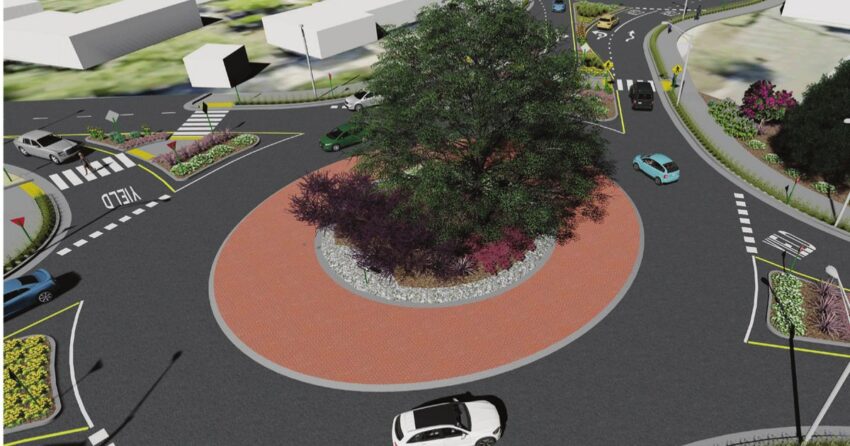
Napa has spent a decade planning its way out of the five-way tangle where Silverado Trail meets Third Street, Coombsville Road and East Avenue. The fix is two roundabouts. The price includes the little white cottage on the corner — the one locals call the Christmas Tree House — and the last of the money to buy it fell into place in May.
The draft environmental report for the Five-Way Intersection Improvements Project, published by the City of Napa and Caltrans in August 2025, calls for full acquisition and demolition of 801 Silverado Trail. The city’s Historic Resources Inventory lists the 1,716-square-foot Mediterranean Revival cottage, built in 1939, as the Josephine and Leno Rossi House, one of about 70 contributing properties in the East Napa Historic District. It is the only home the project takes outright, and it is still owner-occupied: the report’s right-of-way table lists the owner as the Charles P. Rossi Trust.
A house that can’t be moved
Engineers looked at relocating the cottage rather than razing it. The report closed that door: “given the style of construction and foundation type it was determined the structure could not feasibly be moved.” The house is concrete block over a raised basement, and concrete block doesn’t travel.
Because the house contributes to a historic district, the report rates the demolition a significant and unavoidable impact — the label California environmental law puts on damage that mitigation can’t fix. The mitigation on offer is documentation: the house gets formally photographed and recorded before it comes down.
The corner itself is the reason. The city counted 10 reported collisions in the project area over the most recent five-year study period, a rate above the statewide average for similar intersections, and its 2022 Local Roadway Safety Plan ranks this stretch of Silverado Trail — which doubles as state Highway 121 — among the highest-injury corridors in Napa. The design puts a four-leg roundabout at Silverado Trail, Third Street and East Avenue and a smaller three-leg roundabout at Coombsville Road, stitched together with a 10-foot shared-use path.
The council chose this layout — Alternative 5F in the planning files — on Feb. 7, 2017, after winnowing 13 concepts. One rejected option would have spared the Rossi house, but it required buying four commercial properties outright, cut into the state-owned Napa Valley Expo grounds and drew neighborhood doubts about whether it could still handle traffic in 2040. The chosen design takes one home and slices smaller pieces from nine other parcels, including Napa Tire & Wheels, Posh Motors and Napa Marble & Granite Works.
The money just fell into place
What changed this spring is the checkbook. On May 20, the Napa Valley Transportation Authority board put the last $2 million into the project’s right-of-way phase — state Local Partnership Program incentive money the agency qualified for after county voters passed the Measure U sales tax in 2024. That completes a $5.15 million land-purchase budget, alongside $1.15 million from the state transportation improvement program and $2 million in federal One Bay Area Grant funds.
The vote matters because of a rule the authority’s staff spelled out plainly: Caltrans “will not enter into a cooperative agreement for any phase that is not fully funded.” Until the gap closed, the city could not sign the agreement that lets it start buying property on a state highway. Now it can.
The rest of the machinery is already in place. The city signed Mark Thomas & Company in September 2025 for final design and right-of-way services, a contract worth up to $3.26 million, and added a project-management contract in December. Any purchase runs under the federal Uniform Relocation Act, which requires an appraisal at fair market value plus relocation assistance for whoever is displaced. The environmental report conservatively counts two displaced residents.
The bill has grown with the wait. When the council picked the design in 2017, staff pegged construction at $8 million to $12.7 million. By 2023 the whole project penciled out around $23 million. The authority’s current countywide project list carries it at $35 million, with construction starting in 2028 and running about two years.
The house that slowed its own demolition
The cottage has already left its mark on the schedule. When the California Transportation Commission shuffled the project’s funding in June 2025, it wrote that the delay was “due to the project’s impacts on the Napa Historic District, which now requires a more in-depth Environmental Impact Report/Environmental Assessment.” The house helped slow the project that will remove it.
That fuller environmental report circulated for public comment last fall, and the final version was due this spring. As of this week it has not been published. Whenever it lands, the sequence is set: certify, appraise, negotiate, acquire, demolish.
Before the wrecking crew arrives, the mitigation plan requires one thing first — a full set of archival photographs. The Christmas Tree House gets a last portrait for the record.