

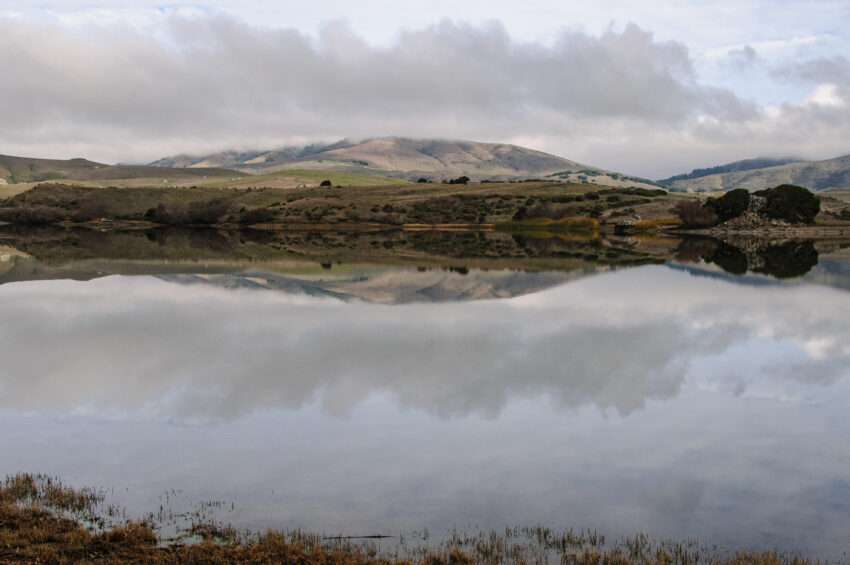
On Tuesday, Oct. 14, the Sonoma County Board of Supervisors sat as the board of Sonoma Water and approved a 15-year contract with the Marin Municipal Water District. It was Item 17 on the consent calendar. The vote was 5-0. The minutes record no discussion.
The staff report in front of the supervisors walked through what was changing. Marin’s annual limit: unchanged at 14,300 acre-feet. Its minimum purchase: unchanged at 5,300. The delivery caps would be “simplified,” the report said. Seasonal acre-foot limits would be eliminated and replaced by “updated daily delivery limits — aligned with the 2006 Restructured Agreement.”
The number that actually changed is not in the staff report. It’s in Section 3(c) of the agreement the supervisors voted to authorize, posted with their board packet.
There, Marin’s maximum delivery rate is set at 25 million gallons a day for January, February, March, April, November and December, and at 12.8 million gallons a day from May through October. Six months at one speed, six months at nearly twice it. And if Marin wants more than 25 million gallons a day, it can ask; Sonoma Water agreed it “will not unreasonably withhold” consent.
The 2006 Restructured Agreement that the staff report invoked caps Marin at 12.8 million gallons a day from May 1 through Oct. 31. It sets no winter rate at all. So “aligned with the 2006 Restructured Agreement” is a fair description of half the deal — the summer half. The winter half is new.
What the winter is for
Marin Water wants to build a pipe.
The Atmospheric River Capture Project would run 13.2 miles and 36 inches wide, from the existing North Marin Aqueduct outside Novato, along Redwood Boulevard and Novato Boulevard and Point Reyes-Petaluma Road, out to Nicasio Reservoir in the hills of West Marin. Two pump stations, a dechlorination plant. Not a foot of it in Sonoma County. Marin puts the cost at about $195 million and allows it could reach $293 million.
The water inside it would be Sonoma County’s. Marin has bought Russian River water from Sonoma Water for decades and can take up to 14,300 acre-feet a year — an acre-foot is 325,851 gallons, by Sonoma Water’s own reckoning, enough to cover an acre of ground a foot deep. Over the past 30 years Marin has averaged about 6,800 of them, a little under half its limit. The reason is plumbing. Marin has no way to store what it doesn’t drink, so it has never had much use for the other 7,500 acre-feet.
Nicasio Reservoir is the place to put it. The pipe is how it gets there. And the winter delivery rate is what fills the pipe when the river’s running high — the entire premise of a project named for atmospheric rivers.
On Tuesday, July 7, Marin’s board approved a $2,658,333 agreement with the U.S. Army Corps of Engineers to design the first 18,000 feet of it. The federal government covers $2 million; Marin ratepayers cover $658,333. The corps will produce finished plans and specifications — the point at which a drawing becomes a blueprint. It’s also, separately, the agency that will have to permit the pipeline under the Clean Water Act.
Twelve and a half million dollars
The October contract came with a check.
Section 5(g) requires Marin to pay Sonoma Water $12.5 million within 60 days of signing. Nine million of it is for “projects to enhance water resiliency within the Russian River System.” The other $3.5 million is for “projects to enhance Sonoma Water’s ability to deliver winter water.”
Sonoma Water banked the money. What it will do with it is still an open question. “Sonoma Water does not yet have an expenditure plan for this revenue,” the staff report told the supervisors, “and will return to the Board when eligible projects have been identified.”
Nine months later, it has not. A review of every Sonoma County board agenda since — 48 meetings, more than 2,000 items — turns up no expenditure plan, no project list and no further mention of the money. Nothing has gone to Sonoma Water’s own advisory committees either. The county adopted its 2026-27 budget on June 12 without programming any of it.
Section 6 of the same contract names the pipeline, in a passage the staff report summarized as an “Infrastructure Planning Shift.” Sonoma Water, it reads, “acknowledges that MMWD is evaluating the feasibility and efficacy of constructing, at MMWD’s sole cost and expense, a new aqueduct from the existing North Marin Aqueduct to MMWD’s Nicasio and/or Soulajule Reservoirs.”
So the record isn’t that Marin sprang a pipeline on its neighbor. Sonoma Water knew, wrote it down, took $3.5 million to help move winter water and signed.
The comment Sonoma Water didn’t file
In March, Marin Water opened the environmental review and mailed notice to the agencies with a stake in it. Its own scoping summary lists who got one. Sonoma County Water Agency is on that list. So is the State Water Resources Control Board, which holds the water rights the whole thing runs on.
When the comment period closed at noon on Monday, April 13, neither had filed anything.
Sixty-nine letters came in. Caltrans wrote. The Native American Heritage Commission wrote. Novato, two school districts, the Nicasio landowners and Marin Audubon wrote. And Russian Riverkeeper — a Sonoma County group with no seat at the table and no water to sell — wrote three times.
Its April letter goes straight at the seam. Marin has told regulators the project “would not modify the District’s existing agreement with Sonoma Water.” True, says Riverkeeper, and beside the point.
“It is important to distinguish between the legal framework of the contract and the functional use of that contract,” the group wrote. “While the agreement itself may remain unchanged, the environmental consequences associated with when and how water is diverted, conveyed, treated, and stored may differ under Project conditions.”
The letter asks the review to answer four questions Marin has not: whether the pipeline shifts more of Marin’s use into winter storms; whether it raises deliveries in wet years when Marin historically bought less; whether it leans on Sonoma Water during short, high-flow events; and whether describing the project as changing nothing about the contract “may obscure operational changes that could influence environmental conditions.”
The San Francisco Bay Regional Water Quality Control Board, which did file, was blunter. “There is very limited information available on the water supply agreement between Sonoma Water and Marin Water that validates the proposed Project purpose to specifically store atmospheric river flows or ‘excess water’ for later use during dry periods,” its engineer wrote. It was unclear, she added, whether any environmental review had evaluated the impacts that “changes to Russian River water deliveries that may result from this Project could have on the Russian River watershed during dry periods and drought.”
Sonoma Water was positioned to answer that. It said nothing.
It’s not as though nobody in Sonoma County asked. When the deal went to Sonoma Water’s own advisory committee of contractor cities last August, the presentation was given by Marin Water’s staff. Brenda Adelman, of the Russian River Watershed Protection Committee, asked how “surplus water” was defined, and how much of it would end up in swimming pools in Marin. The committee recommended approval. The city of Cotati voted no.
A smaller river
All of this is aimed at a river that’s losing its biggest transfusion.
For most of a century, PG&E’s Potter Valley Project has pushed Eel River water through a tunnel into the headwaters of the Russian. Sonoma Water’s own accounting, in a fact sheet it hands to legislators, tracks the drop: an average of roughly 150,000 acre-feet a year between 1922 and 2005; about 60,000 from 2007 to 2020; and 30,000 to 40,000 since 2021, as Scott Dam aged and its seismic risk caught up with it.
PG&E filed to surrender the license in July 2025. The replacement — a seasonal pump station called the New Eel-Russian Facility, to be built where Cape Horn Dam is coming out — is meant to keep some of it coming. Sonoma Water anticipates diversions “up to 30,000 acre-feet/year,” and models Lake Mendocino landing near 51,000 acre-feet under the new facility, against 57,000 under the system as it runs today. With no diversion at all, that number is 25,000.
The Sierra Club’s San Francisco Bay chapter pointed the environmental review at a 2026 U.S. Geological Survey study projecting Russian River droughts 59% longer and 54% more severe than the historical record, with seasonal low flows down 26%. The same modeling, it wrote, shows Lake Mendocino falling below deadpool in as much as 12.3% of future days without Potter Valley water — against 0% historically. It called the replacement facility “speculative and unfunded.”
Marin says the pipeline yields up to 3,800 acre-feet in a dry year. The Sierra Club noted Marin’s own technical memo contemplates a buildout nearly twice that, and asked the district to pick a number.
Tuesday
The next move is in Washington.
The Water Resources Development Act of 2026 was introduced in the House on Monday, June 29. Buried in Section 307, under the heading “Sonoma and Marin Counties, California,” is item 644. It authorizes “$60,000,000 for water and wastewater infrastructure, including water supply, stormwater management, surface water protection, and environmental restoration, in Sonoma and Marin Counties, California.”
That’s the entire provision. Neither water district is named. Neither is the Russian River, Nicasio Reservoir or any project. No member of Congress has publicly claimed it. It’s an authorization ceiling, not money — the same kind of authority that produced Marin’s $2 million and, through it, the Army Corps design deal.
Marin’s board has already been briefed. At the July 7 meeting, watershed resources director Shaun Horne told the directors the district and Sonoma Water had been notified they were in a line item “for a much larger amount, about 60 million, that would be shared between the two.” Marin, he said, is “in conversation with Sonoma Water about what that looks like for Marin.” Board President Jed Smith told him not to get anyone too excited yet.
Sonoma Water has said nothing publicly about any of it.
The House Transportation and Infrastructure Committee marks the bill up Tuesday, July 14.
After that
Marin’s draft environmental report lands this summer or fall. Construction is penciled for 2027 through 2029, water moving by 2030. The contract Sonoma’s supervisors approved on consent runs to 2040.
Grant Davis, who has run Sonoma Water for 16 years, retires Aug. 25. No successor has been named. Whoever takes the desk inherits a river with less water in it, a set of water rights the state has never enlarged, $12.5 million with no plan attached, and a neighbor with a federal partner, a design contract and six months a year at 25 million gallons a day.
The pipe gets designed either way.