

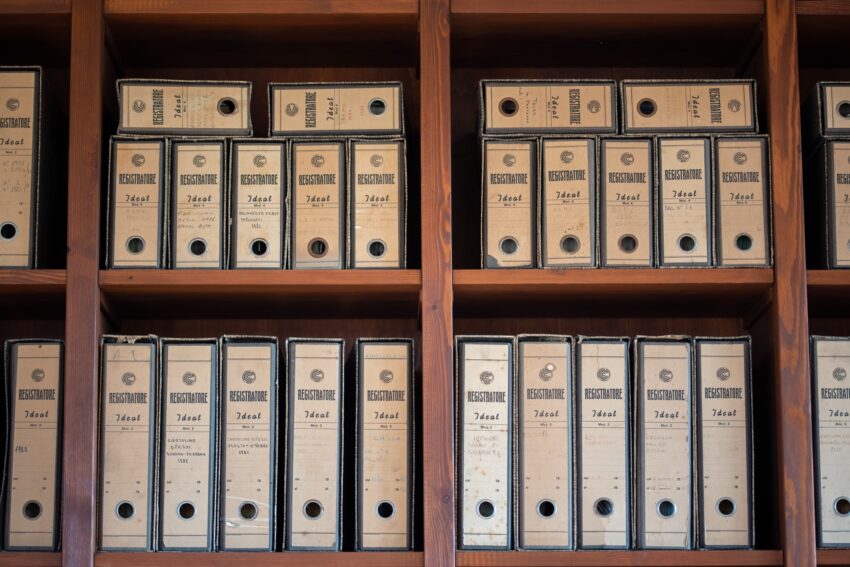
Brenda Adelman kept 45 years of records on the Russian River. Now she needs somewhere to put them.
The files are stacked in a Guerneville house — more than 100 boxes of permit comments, environmental reports, monitoring data and correspondence, with the overflow in a rented storage unit. The woman who filled those boxes turns 87 in September, and she can’t lift them anymore.
“I’m sure most of it would have to be thrown out, but I think there’s a lot of important stuff,” Adelman said in a phone interview Sunday. “I have a lot of important EIRs and things. I’ve written a lot, an awful lot.”
Adelman ran the Russian River Watershed Protection Committee for 45 years, most of it from her home office and most of it unpaid. The group folded this spring, and the Sonoma County Board of Supervisors honored her with a gold resolution June 2. Now she’s closing the nonprofit’s books, thinning the files as fast as a bad back allows — she cleared more than 20 of her 35 boxes of old newspaper clippings over the winter — and looking for an archive, a library or a person willing to take the rest.
“You’re welcome to give out my name and email as a contact if you run into anyone who might be interested in helping at all,” she said.
Adelman started in the early 1980s with the sewer system in her own backyard. Then came the 1985 flood, and with it a major sewage spill from Santa Rosa into the river. She spent the next 12 years fighting the city’s wastewater discharges — a stretch that, by her count, drove four environmental impact reports, the last one running about 24 volumes and costing upward of $16 million. When three salmon and steelhead runs were listed under the Endangered Species Act, the rules tightened and Santa Rosa was persuaded to pump its treated wastewater to the Geysers steamfield instead of the river. People have given her partial credit for that outcome, she said. Agency staff knew her; she was always in the room.
“I’d show up at meetings where no one else from the public was there,” she said. “I’d go to meetings where they were inner sanctum meetings in staff rooms. But they got to know me, and I was always respectful and thoughtful. And I didn’t talk a lot. I just wanted to know what they were doing.”
That was the method. “Someone has to do the grunt work and study the issues and know what they’re talking about to get credibility,” she said. “It’s one thing to get up and make a bunch of signs and be gung-ho and go to all these demonstrations. That’s necessary also, but it’s not necessarily going to do the real work behind the scenes.”
She never drew a real salary for any of it. “I care more about doing this work than I care about having a lot of money,” she said. “A lot of my best work is done at midnight. I’m sort of a night owl.”
Her last big fight may be the one that pays off after she’s gone from it. For the past seven or eight years Adelman bore down on the Russian River County Sanitation District, the troubled Guerneville-area sewer system whose spill history she has documented since the system was two years old. This winter’s spill — reported at 5.5 million gallons, later revised to about 5 million by her account — was the biggest yet, and it happened, she notes, before the river even reached flood stage. That had never happened before. Six months later there has been no fine and no lawsuit; court records and the regional water board’s pending-orders page showed nothing as of Saturday.
But the repairs are finally funded. After a consultant’s study found nearly half the components in the district’s 11 pump stations needed work immediately or soon, Sonoma Water went hunting for grants and came back in May with the whole thing: about $48 million in state money, enough to cover the critical fixes without billing a small community that couldn’t pay.
“Everyone the whole time was expecting to get half that much,” Adelman said. “Nobody dreamed, nobody dreamed we’d get the whole thing.”
So the pipes may get fixed. What doesn’t get fixed by money is the watching. Asked who takes over the wastewater beat she worked alone for four decades, Adelman doesn’t have an answer. Don McEnhill, who ran Russian Riverkeeper for more than two decades before stepping back last year, “does a lot of stuff on the river, but he doesn’t have the same focus that I do,” she said. Fishery groups watch the fish. Timber groups watch the logging plans. Nobody, she said, reads the sewer permits the way she did.
“Really, there’s nobody to take my place. Nobody’s going to do the same things I’ve done.”
Which brings it back to the boxes. Adelman has talked with columnist and Sonoma County historian Gaye LeBaron about what to do with them. She approached Sonoma State a couple of years ago, she said, and was told archiving the collection would cost money the all-volunteer group never had. So the files sit — the paper trail of the permit fights, spills and public meetings that shaped the lower river since the early 1980s — waiting for a taker while she sorts what she can, slowly.
“It’s just a goal of mine to see how much one person can accomplish in fighting city hall,” she said.
The proof is in the boxes. Anyone with archiving help to offer — a university, a historical society, a library, a stubborn volunteer — can reach Adelman at rrwpc@comcast.net or P.O. Box 501, Guerneville 95446.