

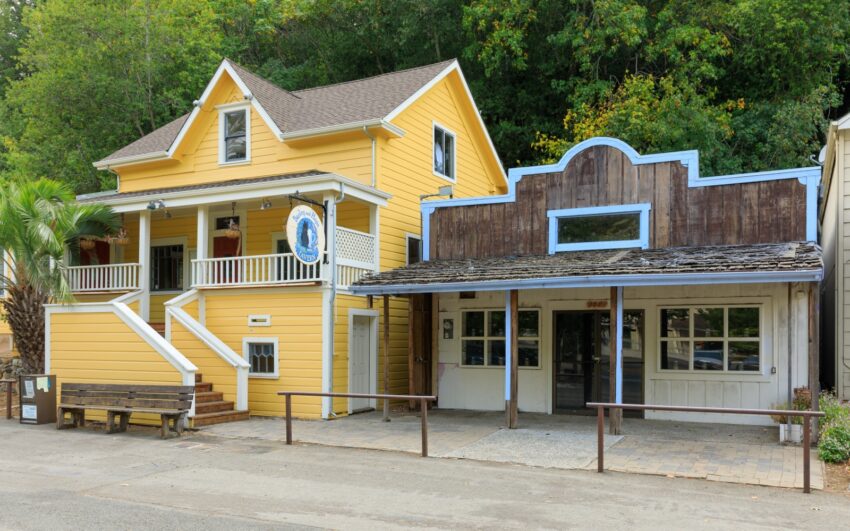
Sonoma Water’s final report on combining West County’s sewer systems, dated Oct. 28, says the roughly 100 ratepayers in Occidental pay “among the highest sewer rates in the state, despite partial subsidies from Sonoma Water.”
Occidental residents and business owners who read the draft asked the agency to put something in the final version about relief now, while the long-term plan plays out. The final version answers each of them with the same sentence: “Emergency relief for current Occidental ratepayers was outside of the scope of the PAR and Feasibility Study.”
PAR is the Project Advancement Report, the 95-page document that closes out a study the North Coast Regional Water Quality Control Board ordered after the Russian River County Sanitation District’s sewage spills in 2019. The four West County sewer agencies, Occidental among them, serve roughly 10,500 people, the report says. The largest spill in the Guerneville system’s history, more than 5.5 million gallons of untreated effluent into the Russian River, happened in January 2026.
What an Occidental home pays
A single-family home in the Occidental County Sanitation District pays $3,294 a year for sewer service in the fiscal year that began July 1, or $274.50 a month, according to the district’s spring 2026 rate notice. That’s up 4.7% from $3,146. The Sonoma County Board of Supervisors, which sits as the district’s board, adopted the rate May 12 on a 5-0 vote, according to the meeting minutes. One member of the public spoke at the hearing, which covered all eight sewer districts and zones Sonoma Water runs.
The adopted ordinance spells the charge out as “three thousand one hundred and forty-six dollars,” the old rate, beside the numerals $3,294.00.
The report counts about 100 ratepayers. Sonoma Water’s budget for the district lists 99 parcels. The rate notice counts 273 equivalent single-family dwellings, the billing unit, because apartments and commercial buildings are assigned more than one. The budget revises that to 203 for this year. The district covers 55 acres.
The district trucks all of its wastewater from a pumping station in Occidental to the Airport-Larkfield-Wikiup treatment plant, according to the notice. Staff’s written response to rate objections this spring put it more bluntly: the district “is currently forced to truck out sewage.”
Where the rest of the money comes from
The bills cover about a third of what the service costs. A March 2026 memo by Jake Spaulding, Sonoma Water’s financial services division manager, says sewer charges make up “approximately 32% of the total revenue needed to provide service.”
Sonoma Water’s general fund has put more than $4.8 million into the district over the past five years, the memo says, and is projected to add $6.2 million over the next three, “making up more than 76% of the total estimated revenue for the District.”
For this fiscal year the memo projects $631,700 from sewer charges, $1,318,000 from the general fund and $2,533,934 in spending, with the district drawing down its reserves by $541,344 to close the gap. Spending works out to $9,281 per billing unit against a rate of $3,294.
“The proposed rate is the lowest the rate can be set given the need to maintain reserves, the structural deficit of the District, and the risks and uncertainties associated with receiving other sources of funding,” Spaulding wrote. The memo pencils in another 4.7% increase next July, to roughly $3,449.
The district’s budget says it without percentages: “The Occidental CSD is facing very serious financial and operational difficulties. Even though rates for the Occidental CSD are the highest in Sonoma County and represent a significant concern for businesses in the district, the very small rates base results in revenues being insufficient to cover routine operating expenses.” The general fund transfers, it says, “will not be recovered from the Occidental CSD.”
Sonoma Water does run a rate relief program for low-income property owners, paid from its general fund, that can cut the annual charge by up to 50%. In Occidental it reached five eligible applicants in the fiscal year that ended in June, for $7,865 in credits, according to the slides staff presented at the May hearing.
The fix is years out
The report’s preferred plan folds Occidental, Graton and Forestville into one system with a new treatment plant in Forestville. The first step is already underway: a pipeline to carry Occidental’s untreated wastewater to Graton’s plant, with design and environmental review due by December 2026, paid for by a $1.45 million U.S. Environmental Protection Agency grant secured in May 2025. The district will seek state revolving fund money to build it.
The report’s roadmap puts pipeline construction in 2029, lasting two years. An agreement to consolidate the Occidental and Graton districts is listed for 2031. Design and construction of the combined Forestville plant is listed to start in 2032 and run five years.
The memo says the rate increase is needed to fund an estimated $14 million in capital projects over five years, the pipeline among them, and that a future grant will have to cover the pipeline’s construction.
What Occidental told the agency
Matthew Meblin, in a comment on the draft, wrote that “Occidental is burdened with some of the highest sewer fees in California, if not the country,” and that the costs make it hard for local businesses to compete with towns that pay far less.
“The timeline for meaningful relief appears to be many years, possibly even decades,” Meblin wrote. “Some businesses may not survive long enough to benefit from the eventual improvements.” The comment asks the agency to recommend temporary rate reductions, hardship programs, grants, subsidies or a revised commercial rate structure. A second comment, with no name attached in the report, repeats it nearly word for word.
Kim Dion, who lives and works in Occidental according to the comment, wrote: “I want to add my voice to our town’s request for short-term sewer rate relief while long-term solutions are being developed.”
Sonoma Water’s longer answer to Meblin is that the study was ordered to explore regional approaches, that it doesn’t rule out local solutions, and that detailed finance plans will be required later but “are not possible for this reconnaissance-level effort.”
In the community survey attached to the report, one respondent who identified as a landlord wrote of “near 9% annual rate increases, no end in sight. Our governance continues to blindly approve increases.” Sonoma Water’s rate memo shows 4.7% increases for last year, this year and next.
Another respondent wrote: “High sewer rates are absolutely killing Occidental.”
Get the Gazette by email
The day’s stories from Sonoma, Napa, Lake and Mendocino counties, picked by the editor. Free.