

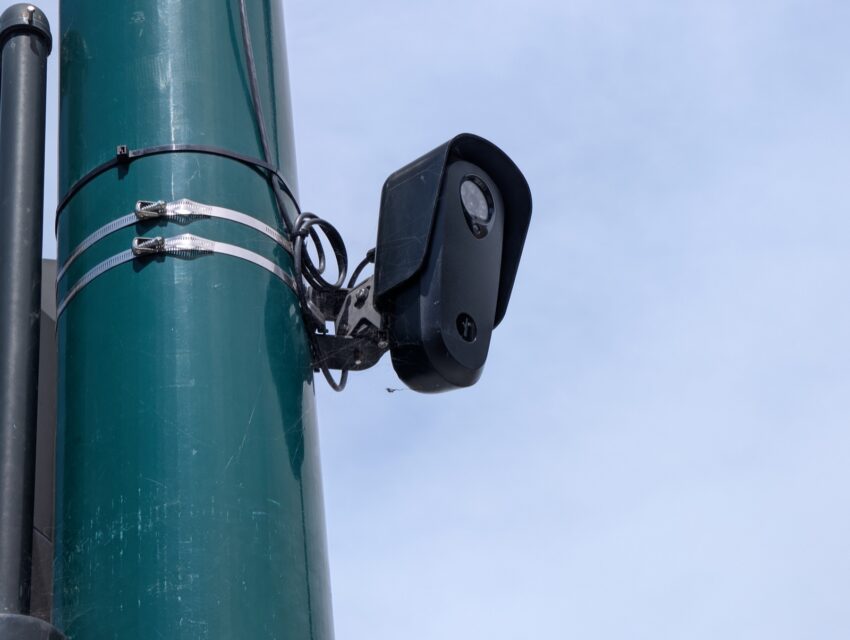
Lake County will hold a public town hall on automated license plate readers, or ALPRs, Wednesday, Nov. 18, from 5:30 to 7:30 p.m. at the Soper Reese Theatre, 275 S. Main St., Lakeport, the county announced Tuesday.
The release says “local law enforcement officials” will explain the technology, “such as FLOCK cameras,” its role in public safety and “the policies and safeguards in place to protect individual privacy rights.” It doesn’t name the agencies, say who asked for the meeting, or say how many cameras are up. Nothing on a Board of Supervisors agenda since Aug. 18 mentions it. Residents who want a question considered must submit it by Sunday, Nov. 15, through an online form at surveymonkey.com/r/853QQRT. The meeting will be recorded and posted to the county’s YouTube channel.
66 cameras, 3 agencies
Three Lake County agencies run Flock Safety cameras: the Sheriff’s Office, Clearlake police and Lakeport police. The cameras photograph passing vehicles, read the plate and check it against hot lists of stolen and wanted cars. Officers can search the stored reads. Flock posts a public transparency page for each agency. The pages, updated Tuesday, list the camera counts: 25 for the sheriff, 30 for Clearlake and 11 for Lakeport. All three keep images 30 days.
The Press Democrat had them at 26, 31 and nine in January. In March, Sheriff Luke Bingham told the Big Valley Advisory Council in Kelseyville the Sheriff’s Office had 29 cameras plus “5 or 6 for the Northshore,” with more coming at Highland Springs and Middletown, and that “Lakeport has 11 and Clearlake has 23,” according to the council’s minutes.
Bingham told the Kelseyville group the county spends “about $71,000” a year on Flock, that the cameras sit at “exits and entries in the county or at major intersections,” and that “if you drive around 20 or 30 minutes in the county, you will be on camera at least 52 times,” the minutes say. He said images are purged after 30 days, “only California agencies can access them,” and searches require a case number. He cited a Lower Lake homicide in which a Flock camera gave deputies a suspect lead and said some cameras have been stolen. Sheriff’s releases this fall credit Flock alerts in a September burglary case between Lakeport and Nice and an October stolen-property case in which the vehicle was tracked into Clearlake.
Clearlake’s page shows the volume: 54,976 unique plates read in the past 30 days, 286 hot-list hits, 84 searches by officers. The sheriff’s page shows 106 searches in 30 days. Lakeport’s shows seven, and Lakeport is the only one of the three that posts a downloadable audit of each search and the reason the officer typed in.
Who gets the data
The sheriff’s page lists 312 agencies “granted access” to Lake County’s plate data, from Clearlake and Lakeport police to the Mendocino County Sheriff’s Office, the California Highway Patrol, Cal Fire, the state Department of Corrections and the Los Angeles Police Department. Every one is in California; no federal or out-of-state agency appears. Clearlake lists 124, also all in California. Lakeport’s page shows no sharing list at all. The sheriff’s 2024 contract also includes Flock’s “State Network” and “Nationwide Network” plate-lookup features, which let an agency run a plate against every camera opted in to those networks.
State law requires agencies that use plate readers to post a usage policy. The sheriff’s, dated January 2024, and Clearlake’s, revised September 2025, are nearly word for word the same, both written from the same Lexipol template, with a few differences. Both say no reasonable suspicion is needed to run a plate and that data goes to other law enforcement agencies only on a written request. The sheriff’s version says audits happen “on an as needed basis.” Clearlake’s says “on a regular basis,” and adds a line the sheriff’s lacks: the chief “may pre-approve other law enforcement or prosecutorial agencies to access ALPR data via Flock’s sharing feature,” with no request-by-request approval. The sheriff’s and Clearlake’s Flock pages list immigration enforcement, traffic enforcement, harassment and personal use as prohibited.
How the county bought in
The Board of Supervisors first approved Flock on June 15, 2021, as a consent item: a two-year lease of 26 cameras for the Sheriff’s Office at up to $65,000 a year, with formal bidding waived. Three months later, on Sept. 28, 2021, the board voted 5-0 for a second two-year lease of 19 cameras, this one written to the County Administrative Office rather than the sheriff and presented by Supervisor Eddie Crandell. The record doesn’t say what those 19 were for. Minutes of the East Region Town Hall’s Jan. 7 meeting in Clearlake Oaks note, under Crandell’s report, a mobile Flock camera on Sulphur Bank Drive and another “on top of the hill for illegal dumping identification.”
On Feb. 27, 2024, the board renewed the sheriff’s program for five years: 26 cameras at $68,500 a year, $342,500 in all, 30-day retention, presented by then-Undersheriff Bingham. The lease passed 3-1, Supervisor Michael Green voting no and Supervisor Moke Simon absent. Nobody from the public spoke.
Clearlake started first. Its cameras went up in September 2020. By January 2021 the city had 14 and had recovered 20 stolen vehicles, Lake County News reported that month, when the council voted 4-1 to expand the network at a cost of up to $65,000. Lakeport joined in January 2022 on a 4-1 vote after then-Lakeport Police Chief Brad Rasmussen told the Lakeport City Council the county and Clearlake systems had already registered stolen vehicles from Lakeport, Lake County News reported. Lakeport extended its contract for five years in January 2024 at $25,000 a year.
A Lakeport vote and a dead state bill
The town hall comes two weeks after the Lakeport City Council votes Tuesday night on a separate $140,900 contract for 13 Intelvi AI cameras, four of them plate readers, that police installed as a pilot without a council vote.
Statewide, the Legislature failed for the fifth year running to pass new limits on plate readers. Senate Bill 1013, which would have made police archive plate data after 60 days and get a warrant to search it, cleared the Senate and died in the Assembly on Aug. 31 without a floor vote, CalMatters reported. The attorney general has sued the city of El Cajon and contacted 18 other agencies since 2024 over sharing plate data with out-of-state and federal agencies, which California law prohibits. Flock said in August it would require case codes on every law enforcement search by the end of this year after a Washington Post review found at least 46 officers nationwide accused of using the cameras to track people they knew, Al Jazeera reported.
The release says the county “is committed to providing opportunities for public education, transparency, and meaningful community engagement on matters involving public safety technology.”