

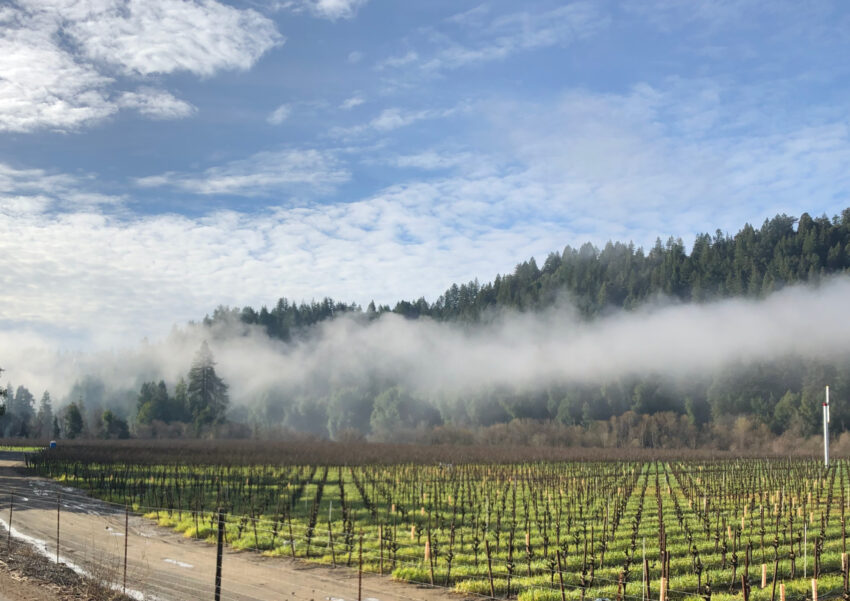
The logging plan that had Jenner looking uphill and worrying about its drinking water is dead. What happens to the 1,099 acres it covered is now the open question on the lower river.
What was proposed, and who pushed back
Bruce Berry proposed the plan in early 2025: a nonindustrial timber management plan, the state’s long-term harvest plan for smaller family forestland — available to owners of less than 2,500 acres. Unlike a standard timber harvest plan, an NTMP has no expiration date once approved.
The property rises from the river’s north bank near Jenner, hard against the Jenner Headlands Preserve. Opposition organized quickly around two things the hillside holds: the salmon-bearing watershed below it, and the village water supply inside it. Jenner Gulch feeds the 100,000-gallon tank that serves most of the town’s homes, and residents argued sediment and chemicals loosened by logging could reach it. Environmental groups pointed to the watershed’s imperiled salmon runs.
The plan drew rounds of review from multiple state and regional agencies and a thick file of public comment letters before the family pulled it, in a notice dated June 6 that gave no reason. An approved NTMP would have let the family log under the plan indefinitely by filing notices of timber operations — no new environmental review each time.
Withdrawn is not protected
Anyone tempted to call this a win and move on should notice: nothing about the land changed. It is still private forestland, and its owner still holds every option he held two years ago — a revised harvest plan, a sale, or something else entirely. Berry told the Press Democrat in June he is evaluating the property’s present and future use.
That leaves the neighbors’ question standing. Land beside a preserve, above a village water supply, in a salmon watershed, is exactly the profile that conservation buyers look for — the 5,630-acre Jenner Headlands Preserve next door came together through that kind of deal — a $36 million purchase Sonoma Land Trust closed in 2009 with 10 public and private funding partners, from the county Open Space District to the Moore Foundation, before handing the preserve to The Wildlands Conservancy in 2013. No sale, new plan or conservation deal for the Berry property had been announced as of Saturday.
Why the lower river watches this one
The mouth of the Russian River is the most protected-feeling stretch of the whole watershed, and the least finished. Ownership there is a patchwork: state park, preserve, ranchland, family timber. Every parcel that changes intent changes the map — and the water underneath it. Jenner’s fight over one hillside was really a fight over whether the patchwork holds.
For now, it holds by default. The plan is withdrawn and the hillside is quiet. The question the withdrawal didn’t answer — what those 1,099 acres become — belongs to whatever the Berry family decides next.
FAQ
Can the Berry family log the land anyway?
Not without a new approved plan. Withdrawing the NTMP ended this review; nothing prevents the family from proposing a new harvest plan.
Why did the plan draw so much opposition?
Jenner Gulch supplies most of the village’s drinking water from a 100,000-gallon tank, and the surrounding watershed supports imperiled salmon runs. Residents and environmental groups argued logging risked both.
Is the land going to be sold or protected?
Unknown. No sale, new plan or conservation deal has been announced. The owner told the Press Democrat he is evaluating the property’s present and future use.