

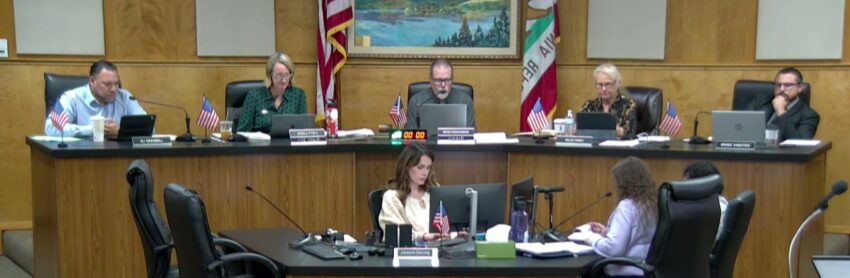
Lake County supervisors voted 4-1 on Nov. 3 to buy a computerized maintenance management system, the kind of software state inspectors found missing from the sewer system that serves Clearlake in 2023.
That’s software that tracks the condition of sewer pipes and pumps and helps crews decide which repairs come first. In November 2023, a state water inspector asked Lake County whether it used one. Scott Harter of the county’s Special Districts office said the county “had a license for City Works at one point but never fully implemented it,” the inspector wrote.
The report’s finding: the county “relies on historical knowledge of problem areas.” The Central Valley Regional Water Quality Control Board released the report in response to a public records request.
The agreement with Tyler Technologies covers a software subscription of up to $141,575 and setup work of up to $423,108, a total of $564,683. The software tracks sewer pipes, pumps and work orders. It will also run utility billing for the county’s Special Districts office.
The county’s own technology committee didn’t endorse the purchase. Special Districts Administrator Robin Borre told the board her office needs it now. “Right now, everything’s in paper,” she said.
The vote came nearly 10 months after the Robin Lane sewage spill in Clearlake in January. On Tuesday, Nov. 10, supervisors are set to accept $2.5 million in state money for repairs at the Southeast treatment plant that serves Clearlake.
What the state found
Inspectors from the State Water Resources Control Board and the Central Valley Regional Water Quality Control Board visited the Southeast system on Nov. 8, 2023. Their report describes about 96 miles of gravity sewer lines, 16.4 miles of force mains, the pipes that carry sewage under pressure from pump stations, and 21 pump stations. The system serves about 13,176 customers.
The regional board’s May 1, 2024, notice of violation cites the Southeast system for three violations. One is more than 1 million gallons of sewage reaching surface waters from 2007 to 2023. The notice also lists seven areas of concern. The seventh reads: “The Enrollee does not use a computerized maintenance management system (CMMS) and relies on historical knowledge of problem areas.” The notice ordered a report on corrective actions by June 3, 2024.
The county’s reply, signed by Harter as Special Districts administrator, calls that finding “not entirely accurate.” It says service requests were logged in the county’s billing and work-order software. It says staff were building a maintenance system inside the county’s mapping software. “It has been a multi-year effort,” the reply says.
More than two years later, Borre’s memo to the board says the sewer district still faces a notice of violation that requires such a system. A lawyer for the Lake County Sanitation District, Claire H. Collins of Hanson Bridgett, wrote to board Chair Brad Rasmussen on Oct. 28 that regulators are requiring the district to install one “immediately.” That notice wasn’t among the agenda attachments, so the record doesn’t show whether it’s the 2024 notice or a newer one.
Why supervisors hesitated
The board first took up the purchase in July. The county’s technology committee recommended waiting until the county’s new Workday financial system was running, according to the Nov. 3 memo. In an Oct. 26 memo, Borre wrote that the county’s IT director, Shane French, said the committee’s recommendation hadn’t changed.
Treasurer-Tax Collector Patrick Sullivan told the board that connecting other software to Workday has “sort of been a nightmare” for his office. He said he didn’t oppose the purchase. But he urged the board not to build more connections to Workday now.
Supervisor Bruno Sabatier said he was ready to approve the maintenance piece, “but the rest makes me nervous.” He also said, “We shouldn’t be on paper and still having a notice of violation.”
Borre said the Tyler system would replace Cascade Wincams, software her office has used since 1998. It wouldn’t replace Workday. “Our billing system crashes a lot,” she said. She said the switch would take a year to a year and a half. The old and new systems would run side by side before the old one shuts off.
Borre said the sanitation district is paying 72.4% of the cost. The sanitation district’s board voted unanimously Oct. 21 to ask the county to approve the deal, the lawyer’s letter says. The county budgeted $778,000 for the project. That includes $213,317 for contingencies and field equipment that aren’t part of the Tyler contract.
Supervisor Jessica Pyska moved both motions, to waive the county’s own bidding process and to approve the contract. Each passed 4-1. Sabatier cast the no vote on waiving the bidding, according to the clerk’s notes. The notes don’t name the no vote on the contract. The board also set up an oversight committee of a supervisor, a sanitation district board member and county administration staff to watch the rollout.
What comes next
The $2.5 million on Tuesday’s consent agenda comes from the state budget act signed Sept. 18. Borre’s memo says it will pay for new headworks at the Southeast plant, where sewage first enters, along with a dump station for septic haulers and a rebuilt mechanical screen. Any money left over would go to designing a new lift station.
Get the Gazette by email
The day’s stories from Sonoma, Napa, Lake and Mendocino counties, picked by the editor. Free.