
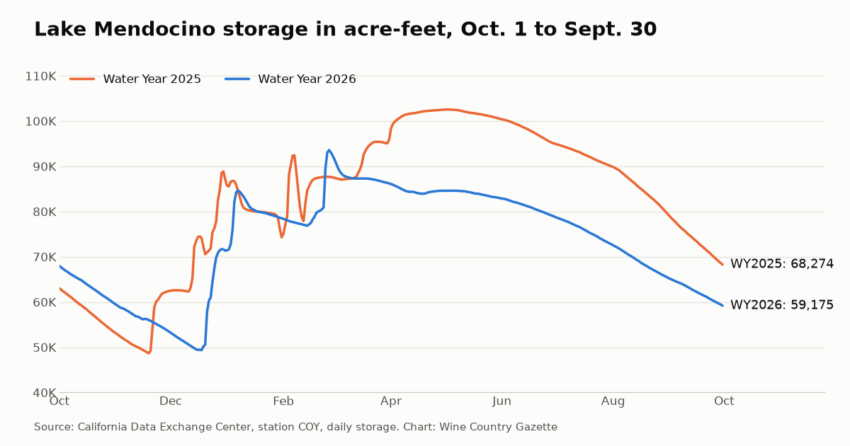
MENDOCINO CO., 10/3/26 — Lake Mendocino closed out the water year Sept. 30 holding 59,175 acre-feet, about 9,100 acre-feet less than on the same day a year earlier, according to daily readings the state posts from Coyote Valley Dam. That’s roughly 13% less water. The surface sits about 5.6 feet lower.
Lake Sonoma went the other way.
It ended the year with 232,774 acre-feet, about 3,100 more than a year ago and a little over a foot higher.
Both lakes got less rain.
Less rain, 2 results
Nick Malasavage, who runs operations for the U.S. Army Corps of Engineers’ San Francisco District, laid out the numbers in a public Sonoma Water webinar Sept. 30, the last day of the water year.
Rain measured at Coyote Valley Dam came in 10 inches below the year before. “So today, as we sit, we’re five feet lower than we were a year ago,” he said.
At Warm Springs Dam, which holds Lake Sonoma, rainfall fell a full 12 inches short of the prior year.
“So a foot less rain, but a foot more storage,” Malasavage said.
In Ukiah, rainfall for the year stood at 30.7 inches through Sept. 27, or 84% of average, according to Sonoma Water.
The forecast did the work
The Corps controls both reservoirs when they rise into their flood-control space, and the rules require it to release water to restore that space. Forecast Informed Reservoir Operations, known as FIRO, lets operators hold water when the forecast is dry and release it early when a big storm is coming, Malasavage said.
At Lake Sonoma, the Corps kept the lake in its flood-control pool until about Aug. 10, Malasavage said.
At Lake Mendocino, the lake went into the dry season with a little over 80,000 acre-feet, said Donald Seymour, Sonoma Water’s deputy chief engineer. Without FIRO, he said, it would’ve held 14,000 to 15,000 acre-feet less and dropped the river into a “critical” water supply condition, with the lowest minimum flows the rules allow.
Instead, the river ran all summer under “dry” rules.
On June 1, Lake Mendocino held 82,870 acre-feet, above the 76,000-acre-foot line for critical conditions but short of the 94,000 needed for normal, according to Sonoma Water’s August filing with the State Water Resources Control Board. The dry designation held the upper Russian River minimum at 75 cubic feet per second and the lower river at 85.
Since 2019, Seymour said, FIRO has added about 135,000 acre-feet of storage across the two reservoirs. “No capital projects, just through improved operations of the system,” he said.
Normal again, with salmon coming
Each fall, Sonoma Water checks Lake Mendocino’s storage against a set of thresholds to decide the river’s water supply condition. Speaking the day before the Oct. 1 check, Seymour said storage would clear the line for normal conditions.
He called the timing great. “We are now observing Chinook, adult Chinook salmon coming to the system to spawn,” Seymour said. Normal conditions mean higher minimum flows in the main stem of the Russian River and in Dry Creek, he said.
Under the state’s Decision 1610 rules, a normal year sets the upper river minimum at 150 cfs from September through March, and the lower river at 125 cfs, according to the filing. Summer reductions written into the current state order run through Oct. 15.
Less water from the Eel
What flows into Lake Mendocino this fall depends partly on the Eel River. That supply keeps shrinking.
PG&E’s Potter Valley Project moves Eel River water into the East Fork of the Russian River. The powerhouse has been dark since a transformer bank failed in 2021, and PG&E said in March 2023 it wouldn’t replace it, according to Sonoma Water’s filing. Losing hydropower ended the discretionary transfers and cut deliveries by as much as 456 acre-feet a day.
PG&E also stopped closing the spillway gates at Scott Dam because of seismic risk, which cut Lake Pillsbury’s storage capacity by about 20,000 acre-feet, the filing says.
Under a flow variance the Federal Energy Regulatory Commission approved May 14, releases from the project into the East Fork drop to 5 cfs from Oct. 1 to April 14 whenever Lake Pillsbury holds less than 36,000 acre-feet. On Sept. 24, Lake Pillsbury held 35,850 acre-feet, according to Sonoma Water’s weekly hydrologic report. The project was diverting 50 cfs that day.
A U.S. Geological Survey gauge on the East Fork near Calpella, above Lake Mendocino, read 42.7 cfs at midday Oct. 1. By 8 a.m. Saturday it read 19.3 cfs, according to provisional USGS data.
Because the Eel no longer reliably feeds the Russian, Sonoma Water has asked the state to keep judging the river’s condition by Lake Mendocino storage rather than by inflow to Lake Pillsbury. “The historical link between the two watersheds upon which Decision 1610 is based no longer exists,” the August petition says.
The petition would also cut summer minimum flows under normal conditions from May 1, 2027, to 125 cfs on the upper river and 70 cfs on the lower, changes Sonoma Water says the 2025 federal biological opinion for salmon requires. The State Water Board is taking objections until Oct. 19.
Ukiah has no right to water released from storage in Lake Mendocino, Sonoma Water says. The city draws on natural river flow, Potter Valley imports and groundwater.
El Nino, with a warning
Seymour said the El Nino building in the Pacific is “off the chart.” A Sonoma Water analysis of Russian River rainfall back to 1951 found no significantly dry years during a strong El Nino, he said.
“It’s going to be somewhere between normal and very wet,” Seymour said.
Jeanine Jones, a consultant to Sonoma Water, urged caution in the same webinar. Of three past strong El Ninos, she said, two were wet, “but 2015-16 was not for California.” After three near-average years, she said, the bigger risk this winter is flooding, not drought. And the National Oceanic and Atmospheric Administration’s seasonal outlooks have scored poorly in California.
“Realistically, we don’t have the ability now to forecast precipitation at these longer time scales,” Jones said.