

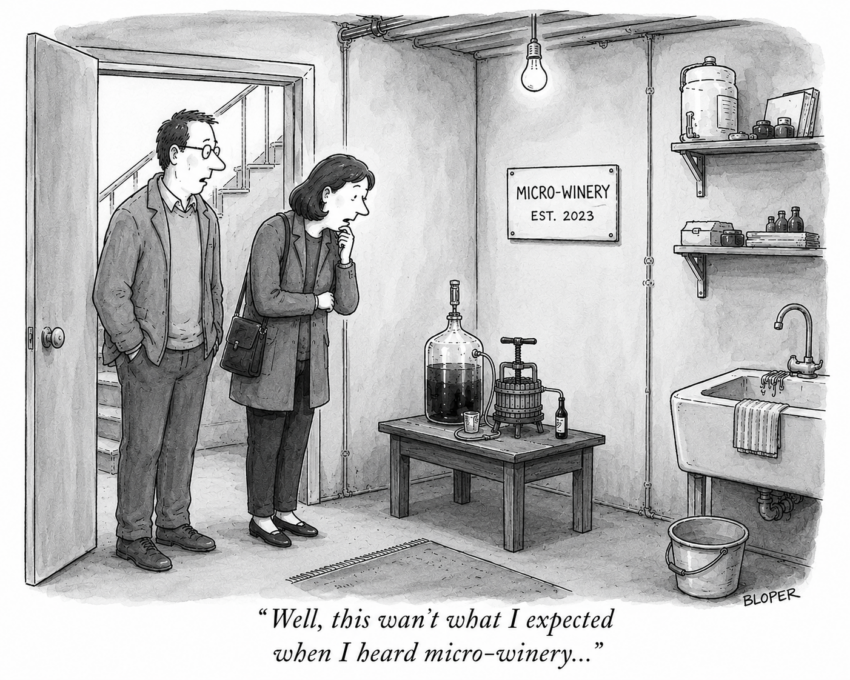
A small-producer trade group that spent years pushing California to legalize tastings out in the vines is now turning that win into a consumer brand.
The Micro-Winery Guild, the rebranded version of the nonprofit Save the Family Farms, announced this week it is launching a Napa- and Sonoma-based collective of family-run wineries that make fewer than 5,000 cases a year, along with a peer-reviewed seal called the T.A.S.T.E. Verified Experience. The seal is meant to help visitors tell hands-on, vineyard-based tastings apart from the corporate hospitality model that has come to dominate both counties.
The timing is not an accident. The guild is rolling out its consumer pitch less than five months after Assembly Bill 720 took effect — the law that, for the first time, lets a licensed winegrower pour wine for paying guests at a vineyard site that is not the bonded winery.
AB 720 was authored by Assembly Member Chris Rogers, D-Santa Rosa, signed by Gov. Gavin Newsom in October 2025 as Chapter 562, and went live Jan. 1. Under the new Type 93 permit, the state Department of Alcoholic Beverage Control can authorize up to 36 estate tasting events per winery per calendar year at vineyard parcels the winery controls but does not bond as a production facility. Save the Family Farms — now the Micro-Winery Guild — was among the bill’s most active backers.
“Small wine businesses across California are opening their vineyards and farms for truly unique tasting experiences,” guild co-founder Elise Nerlove said in the launch announcement. “The Micro-Winery Guild brings structure and visibility to this movement by establishing the state’s first authenticity designation dedicated to small, family-run wineries.”
Nerlove owns Elkhorn Peak Cellars, the Jameson Canyon estate on Polson Road on the south Napa side of the county line. She is one of a handful of Napa growers who pushed the county to adopt its micro-winery permit ordinance in 2022, the local precursor that fed into the statewide AB 720 fight.
What T.A.S.T.E. stands for
The acronym is the guild’s organizing idea, and it doubles as the membership rubric:
- Terroir — vineyard-first, place-driven wines
- Artisan — hosted by the people who farm and make the wine
- Small-Scale — under 5,000 cases a year, family owned, no outside capital
- Trust — unfiltered, unbranded, peer-reviewed for authenticity
- Engagement — guests can ask, learn and taste with the grower, not a hired pourer
To carry the seal, a winery has to meet a written standards document the guild posts on its site, and the visit has to be hosted by the person who farms or makes the wine — not a tasting-room staffer reading from a script.
Who’s in
The launch roster spans both sides of the Mayacamas. Sonoma County members include Van der Kamp Vineyard on Sonoma Mountain, Crux Wineryin the Russian River area and Campbell Cellars. Napa members include Elkhorn Peak Cellars, Paloma Vineyard on Spring Mountain, Frias Family Vineyard, Maroon Wines, Honrama Cellars, Sciandri Family Vineyards, Rahn Estate, Vinatieri Vineyards, Promise Wine, Lost Valley, La Cienega, Hillwalker, FigJam, Chaix, Battuello, Work Vineyard and Tognetti.
The guild says the designation is currently limited to Napa and Sonoma but is planning to expand across the rest of California through 2026.
Why it matters in Sonoma County
For Sonoma growers, the practical effect of AB 720 is straightforward: a winery that owns a vineyard a few miles from its bonded production facility can now legally host a paying tasting out at the vineyard with a state permit, rather than fighting for a use permit through the county’s planning process. For micro-producers without a tasting room of their own — which is most of them — that is the difference between an income stream and no direct-to-consumer access at all.
Sonoma County’s response has so far been more permissive than Napa’s. Napa County is still working through its own implementation guidance after years of contentious debate over winery events, and the county is, as the Press Democrat reported in November, “bracing for the impact” of the new state framework. Sonoma’s existing zoning is closer to what AB 720 contemplates, so the rollout has drawn less local pushback.
For consumers, the guild is betting the seal will function the way an organic certification does at a farmers market: a shortcut to know that the person pouring the wine actually farmed it.
How to find them
A full member list and event calendar — including upcoming Pet-Nat winemaking sessions at Elkhorn Peak, a Grenache walk at Crux, and a Pinot afternoon with the Van der Kamp family on Sonoma Mountain — is posted at microwineryguild.com. Visits are by appointment or ticketed event; most member wineries are not open for drop-in tasting.
—
Wine Country Daily is reader-supported journalism covering Sonoma, Napa, Lake and Mendocino counties.