
Two reservoirs hold up the Russian River, and this summer they are drifting apart. Lake Mendocino, the smaller one above Ukiah, held 77,201 acre-feet on July 10 — about 18% less than it held on the same date a year ago. Lake Sonoma, some 40 miles south near Geyserville, held 253,741 acre-feet, a shade more than it did last July.
The one big difference between the two reservoirs sits on the Eel River — a century-old diversion into Lake Mendocino that PG&E is now moving to decommission.
A widening gap between two reservoirs
The numbers come from the state’s California Data Exchange Center, which posts daily readings from both dams. A year ago on July 10, Lake Mendocino stored 93,644 acre-feet. This year it is down 16,443 acre-feet — roughly 5.4 billion gallons less water behind the same dam on the same date. The reservoir has been dropping about 155 acre-feet a day through the past month, from 81,850 acre-feet on June 10.
Lake Sonoma moved the other way. It stored 250,384 acre-feet on July 10 last year and 253,741 this year, up about 1%. Both reservoirs are drawing down for the dry season, as they do every summer. Only one is starting the summer well short of where it stood 12 months ago.
Why Lake Mendocino is the one falling behind
Lake Mendocino has always leaned on borrowed water. Since 1908, the Potter Valley Project has carried Eel River water across the divide into the Russian River basin — dropping about 470 feet from Cape Horn Dam through a century-old tunnel and out into the East Branch of the Russian River, which runs down to Lake Mendocino. For generations that import helped keep the reservoir full.
That lifeline is closing. The project’s powerhouse has not produced electricity since 2021. PG&E is surrendering its federal license and moving to decommission the project, with a target of filing its decommissioning plans in the third quarter of 2027. In the meantime, the utility has asked federal regulators to sharply cut the flows it still sends through the tunnel toward Lake Mendocino.
Lake Sonoma has no such dependency. Warm Springs Dam impounds Dry Creek, a tributary fed entirely by its own watershed. What falls in the hills above it stays in the basin. Lake Mendocino’s fortunes, by contrast, are tied to a diversion that is being wound down.
What it means downstream
The reservoirs are what keep the upper Russian River flowing through the dry months. Near Hopland, below Lake Mendocino, the river was moving at 91 cubic feet per second on July 10 — a summer trickle held up largely by releases from the dam, which was letting out 125 cubic feet per second while only 58 flowed in. Sonoma Water manages supply from both reservoirs for hundreds of thousands of people across Sonoma and Marin counties, and those daily releases balance instream flows for fish, downstream demand and what is left in storage.
A lower Lake Mendocino narrows that balance. It is not a crisis this July — the reservoir stood at 742.7 feet in elevation on July 10, releasing more than was flowing in, the ordinary summer pattern — but it is a thinner cushion heading into late summer, and a preview of the arithmetic the upper Russian River faces as the Eel imports keep shrinking.
The shortfall is not for lack of trying to hold water. New forecast-informed operating rules, adopted in 2025 for the first time in the dam’s 66-year history, let managers keep an extra 11,650 acre-feet in storage when weather forecasts allow, and officials say the approach has saved nearly 30,000 acre-feet over its trial years. Even with those savings, Lake Mendocino is running well behind last summer — and the imported Eel River water that long helped refill it is precisely what PG&E is now moving to phase out.
What’s next
The federal decision on decommissioning is grinding forward. The Federal Energy Regulatory Commission issued a scoping document in May, held public meetings in Ukiah on June 23 and 24, and is taking written comments through July 24. Its staff has already signaled it does not consider a government takeover of the dams a reasonable alternative. The paperwork will take years. The gauges update every day.
Frequently asked questions
How much water is in Lake Mendocino right now?
About 77,201 acre-feet as of July 10, 2026, per the California Data Exchange Center — down roughly 16,443 acre-feet, or about 18%, from the same date in 2025.
Why is Lake Sonoma doing better than Lake Mendocino?
Lake Sonoma is filled by its own Dry Creek watershed and does not depend on imported water. Lake Mendocino has long relied on Eel River water piped in through the Potter Valley Project, and PG&E has asked federal regulators to sharply cut those diversions as it moves to decommission the project.
What is the Potter Valley Project?
A PG&E hydroelectric project dating to 1908 that diverts Eel River water through a tunnel into the East Branch of the Russian River, helping supply Lake Mendocino. Its powerhouse has been idle since 2021, and PG&E is surrendering the license and moving to decommission the project.
Will this affect summer water supply?
Not acutely this July — Lake Mendocino is drawing down through the dry season as it does every year, and Lake Sonoma is near last year’s level. But a smaller Lake Mendocino leaves a thinner margin later in the season, and the long-term wind-down of Eel imports, as PG&E decommissions the project, is the bigger question for the upper Russian River.
Where do these numbers come from?
Reservoir storage and flow figures are daily public readings from the California Data Exchange Center; Russian River flow near Hopland is from a U.S. Geological Survey gauge. Both are updated every day and open to anyone.
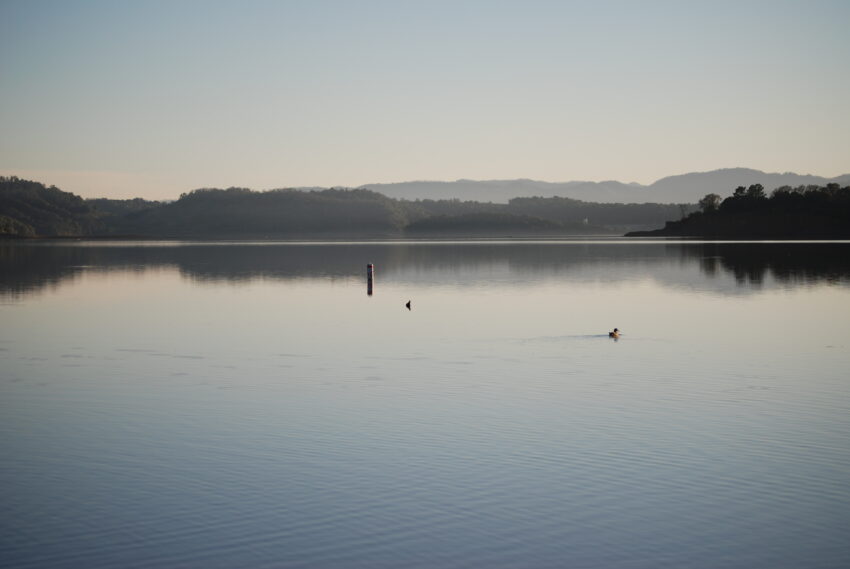
Photo: Lake Mendocino near Ukiah, by Kglavin via Wikimedia Commons (CC BY 2.5).