

Opinion
In Sonoma County, winning the housing lottery may only win you a place in line.
In Santa Rosa, a housing lottery did not give people homes. It decided who could join a waiting list.
That matters when you are 65, on a fixed income, and trying to find stable housing. A place in line is not a roof. A lottery outsources rationing to chance.
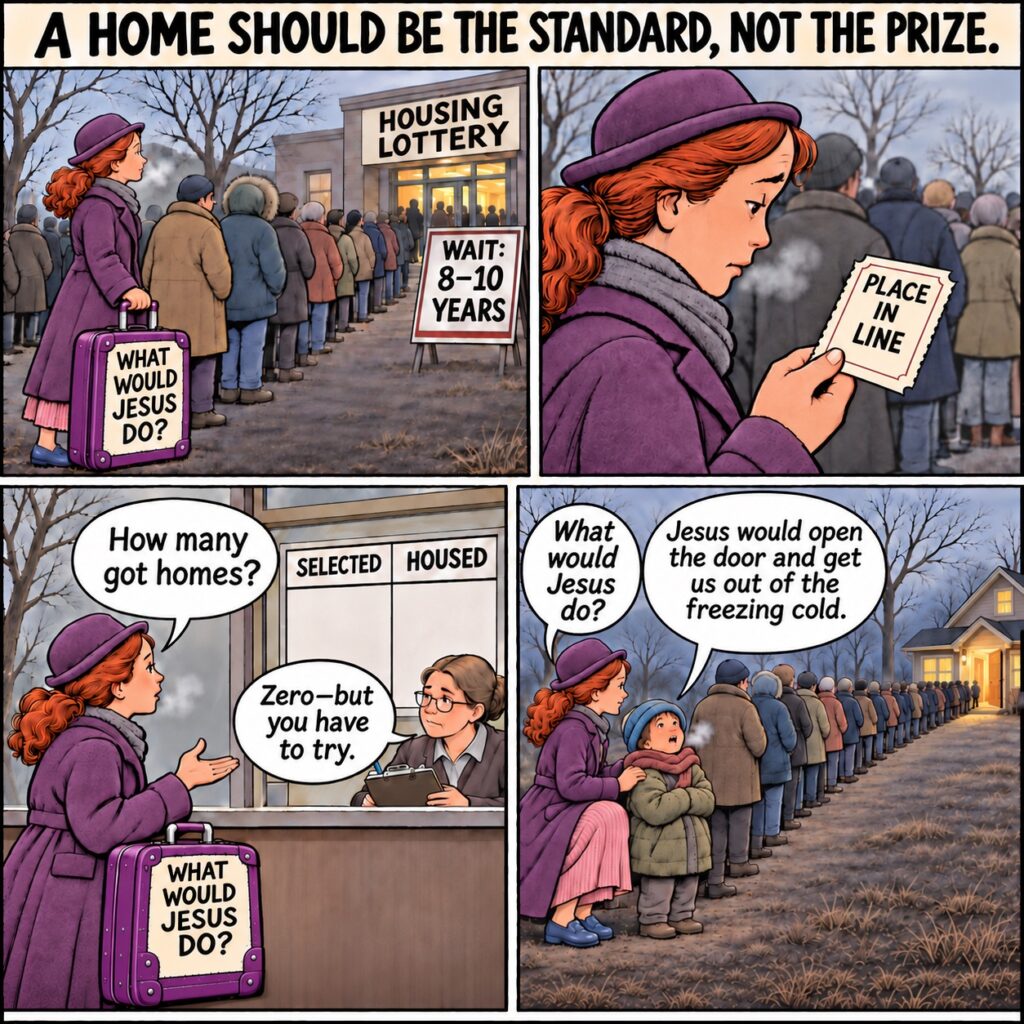
The City of Santa Rosa’s housing plan says its Section 8 Housing Choice Voucher list last opened in June 2023, for six weeks. The Authority received 7,400 applications and randomly selected 5,000 to join the list. About 7,200 families were already waiting, with an estimated wait of eight to ten years. The City’s current program page still says the general list is closed.
Thousands applied for permission to wait. Selection opened another queue, where limited funding and turnover ration assistance. The lottery allocates a place in line, not affordable housing. Even the waiting room has a waiting list.
Outside Santa Rosa, the County Housing Authority randomly selected 750 applicants for its voucher list in October 2023. A March 2025 report said no names had been drawn for assistance because of a funding shortfall. It projected all 750 would have an opportunity for service by the end of 2026.
In a November 18, 2026, response, Deputy Director Martha Cheever said 571 households still wait. The expected 2026 funding did not arrive, she wrote, and she cannot predict when the County can complete the list.
The County cannot say what happened to the other 179 households or track whether they found housing, withdrew, were ineligible, or could not be reached. Cheever lacks counts of households from the 2019 and 2021 lists who received vouchers and leased homes. A name disappearing is not proof someone found a home. Missing data makes results harder to measure.
An “opportunity for service” is only an invitation to apply after responding to mailed notices; it does not assure a voucher or home. The County uses U.S. mail only, citing lack of resources for email or phone. Apparently the transaction cost of reaching people includes an email address. Applicants bear the risk of missed mail and deadlines. The County does not track removals or reinstatements.
As of October 31, 2026, 2,910 of 3,021 allocated vouchers were in use, leaving 111 unused. Cheever said federal funding is inadequate and rules prohibit adding other funds. Average cost: $1,606 monthly. The County says it is not in shortfall and has no action plan, but did not say whether the 111 could go to new households or estimate funding needed. The gap calls for a plain explanation in dollars and households.
Asked about partners, Cheever said they had “no options for households remaining on our waitlists.” She pointed to HUD and California’s housing department for data on extremely low-income households served, but had no comparable County and statewide rates.
Her response listed February 17, 2026, as the next Annual Plan update date, already past when her email arrived. I asked the County to confirm the date and explain in writing why voucher draws are paused if it is not in shortfall and has no shortfall action plan. Those questions remain open.
The County held a separate lottery for project-based vouchers in June 2025. That is not a reopening of the general tenant-based list: project-based assistance is tied to designated properties.
The administrative language is tidy: “waiting list,” “lottery,” “funding shortfall.” The human result is not. A senior cannot pay rent with a lottery result or plan retirement, medical care, or safe shelter around an eight-to-ten-year estimate.
Behind every application number is a human life: someone who has worked, cared for family, survived illness, and hoped for peace in old age. I know how hard it is to seek a home on a fixed income when every answer is another form, line, and year. People keep applying because a safe home is not a prize for the lucky. It is where a person can rest, keep medicine close, welcome a friend, and feel tomorrow belongs to them.
This is rationing under excess demand, with chance deciding who may wait. Applicants pay in years of uncertainty, disrupted health care, and scarce income spent on temporary arrangements. The queue creates no housing supply. Counting names admitted as progress is an input measure masquerading as an outcome. What matters is how many households received affordable homes. A waiting list is very efficient at producing waiters.
Housing is a basic human need. In the Christian teaching I try to live by, neighbors deserve compassion, not a place in a queue. Jesus taught us to see people who are hungry, vulnerable, or without shelter—not congratulate ourselves for giving them a place in line. Faith means making room, telling the truth, and treating people with dignity.
Why should access depend on luck? Agencies should publish how many selected households were housed, how many still wait, how many vouchers funding allows them to issue, and when the next general list will open. These basic measures—placement, attrition, utilization, and time to housing—would let the public compare promises with outcomes. It might even make the system accountable for more than keeping the spreadsheet tidy.
The waiting is personal. I am 65, living on a fixed income, with health needs and the daily uncertainty of trying to secure a permanent home. A waiting-list number cannot protect my health, keep medicine within reach, or give me peace about where I will live next year. Our public system had no trouble taking my money and declaring I could retire. Other seniors, disabled people, parents, and children carry that same uncertainty. Every unmeasured departure is a human story the system cannot call success. The lottery’s prize should be a home. Until agencies can say who was housed—and keep opening doors until people have homes—the process is counting applicants, not meeting the need. Our public systems must show their lives matter by making room for them. False promises are worse than no promises at all.
Reporting notes and sources
The March 2025 County report describes the 750-applicant list’s status at that time and gives a projection. Updated figures and statements attributed to Deputy Director Martha Cheever come from her written email response and attached answers to Renee Cooper, dated November 18, 2026; the County has not confirmed the correct date for its next Annual Plan update.
- City of Santa Rosa, 2024–2027 Consolidated Plan and Annual Action Plan, pp. 76–77; reports the June 2023 opening, 7,400 applications, 5,000 selected, 7,200 waiting, and estimated eight-to-ten-year wait.
- City of Santa Rosa, Housing Choice Voucher / Section 8 program page; labels the general waiting list closed.
- Sonoma County, Housing Authority Annual Plan progress report, March 2025; reports 750 selected in October 2023, no names drawn for assistance as of the report, and a projected opportunity for service by end of 2026.
- Sonoma County, Community Development Committee minutes, July 16, 2025; records a separate project-based voucher lottery running June 1–30, 2025.
- Martha Cheever, Deputy Director, Sonoma County Housing Authority, written email and attached response to Renee Cooper, November 18, 2026 (author’s email records; not a public link).
Renee Belinda Cooper, M.B.A.
Santa Rosa
Get the Gazette by email
The day’s stories from Sonoma, Napa, Lake and Mendocino counties, picked by the editor. Free.