

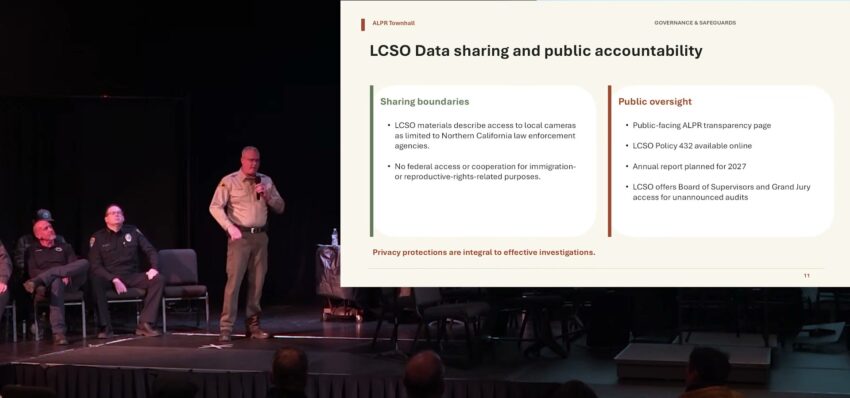
Drivers in Lake County pass about 65 police cameras that photograph their license plates. The Sheriff’s Office now lets 61 other police agencies search its share of those pictures, Sheriff Luke Bingham told a town hall in Lakeport on Nov. 18.
“We do not share our camera access to any agencies below Marin County and across to the Nevada line,” Bingham said.
On Nov. 3, the sheriff’s page on the website of Flock Safety, the company that makes the cameras, listed 312 agencies with access. By Nov. 5 it listed 160, with San Diego, Santa Monica and Huntington Beach police still on it.
Lakeport Police Chief Dale Stoebe said his department shares with “a couple of hundred” agencies now. A new policy, under review by the city attorney, would cut that to 56: agencies in the counties that touch Lake County, plus Sacramento and San Francisco, where he said past crime data shows a link. The policy would also tighten audits, he said.
On Saturday, the county posted the recording of the two-hour meeting at the Soper Reese Theatre. Bingham, Stoebe and Clearlake Police Chief Tim Hobbs answered 12 questions that county officials drew from an online survey of residents. Then they took questions from the audience. Board of Supervisors Chair Brad Rasmussen read the questions. He was Lakeport’s police chief when the city council approved its cameras on a 4-1 vote in January 2022.
A yearly report and open audits
Starting in 2027, Bingham said, the Sheriff’s Office will give the Board of Supervisors a yearly report on its cameras each July, along with its report on military equipment. It will list the results of the office’s audits, any misuse found and what was done about it. It won’t name deputies, he said, because of state protections for officers.
He also said he would let supervisors, city councils or the county grand jury make unannounced checks of how the cameras are used. “Come look at it. Make sure that we’re using it appropriately and it’s not being misused,” he said.
All three agencies keep the pictures for 30 days unless they become evidence in a case. Searches have to carry a case or incident number. Each agency audits searches every month, the sheriff and chiefs said, and Bingham said the sheriff’s audits cover outside agencies’ searches too. An alert alone isn’t enough to stop a car, they said. Officers first check the plate through dispatch or a law enforcement database to confirm the car is stolen or wanted.
Asked whether federal immigration agents can get the data, Bingham said state law bars it, and a federal subpoena would go to county lawyers and be refused. Stoebe said Flock’s system doesn’t let a California agency turn on sharing with federal or out-of-state agencies. “Does that say that it’s not going to happen and never does happen? I can’t say that that’s the case,” he said. Audits are there to catch people who break the rules, he said.
What the cameras cost
Bingham said the sheriff’s 25 cameras cost $68,500 a year, paid from county cannabis tax money. The supervisors renewed the contract, written for 26 cameras, for five years in February 2024, $342,500 in all. No one from the public spoke on it, the meeting record shows. The board first approved the cameras in June 2021 as a consent item, one of a list of routine items passed in a single vote.
Hobbs said Clearlake pays about $55,000 a year for 30 cameras. Stoebe said Lakeport pays about $27,500 for 10.5 cameras. The city’s 2024 contract set $25,000 a year for 10. Lakeport Unified School District pays for two on school campuses, and the county pays for half of one at Vista Point. Together, that’s about $151,000 a year.
Where they are
Bingham wouldn’t say where the sheriff’s cameras are. “We’ve already had two cameras cut down,” he said. “If I tell everybody where the cameras are at, what’s going to happen? They’re all going to get cut down.”
They sit on main roads that people use to leave a crime scene, he said, such as Highways 20, 29 and 53, Soda Bay Road and Scotts Valley Road. They’re not typically in neighborhoods, he said. He said he has no plans to add cameras beyond the 25.
In Clearlake, the cameras sit at main intersections and at the entrances to some neighborhoods, Hobbs said. One neighborhood of 300 to 400 houses has a camera at each of its two ways in. He said the city needs no more locations for now.
Facial recognition
The chiefs said the Flock cameras take still pictures of cars and plates and don’t use facial recognition. Stoebe said he has looked at many of the pictures and has never been able to identify a driver.
One resident asked whether the Sheriff’s Office had used Clearview AI, a facial recognition program, citing a 2022 lawsuit. Bingham said that before he became sheriff, the office got trial access for investigations. “It was used on a very limited basis by one of our investigators and we never purchased the system,” he said. The office doesn’t have it now, he said.
Results, and doubts
Clearlake police said in the presentation that they have used the cameras to solve or identify a suspect or vehicle in about 250 cases. Bingham pointed to a missing person case that turned into a homicide and the Spruce Grove Road shooting, in which he said camera data helped arrest six people.
Several speakers in the audience said they don’t trust Flock with their data. One man said residents never got proper notice before the cameras went up. “I follow the board of supervisors. I read the agenda every week and I never saw it come up,” he said, though he allowed that it may have.
Get the Gazette by email
The day’s stories from Sonoma, Napa, Lake and Mendocino counties, picked by the editor. Free.