

Sonoma County has a written plan for the families of people immigration agents take away. The North Bay Rapid Response Network counted at least 12 people detained across the county Friday. The same day, the county switched on the plan’s first phase: a round of alerts and public messages. Help for a child left behind comes in the second.
The network counted the detentions starting about 6 a.m. Nov. 20, The Press Democrat reported. Two were on Highway 101 at Petaluma Boulevard South. One was near Highway 116 and Occidental Road outside Graton. Early information showed the person arrested there was a woman on her way to work, Karym Sanchez, an organizer with the Graton Day Labor Center, told the paper. ICE officials hadn’t confirmed the detentions, the paper reported. It said a child was left behind in one arrest. The network said the people were taken to ICE field offices in San Francisco, Stockton and Bakersfield, KRCB reported.
That afternoon the county said it had activated “Phase 1 of our emergency contingency plan related to immigration enforcement impacts.” It said the Department of Homeland Security had told it the arrests were targeted. By evening, Assistant County Administrator Jennifer Solito told The Press Democrat that DHS contacts had said so in the morning, “but subsequently, as the day went on … that was not the case.”
Santa Rosa Police Chief John Cregan said in a statement that his officers aren’t taking part in the operations. They learned of them “only after community members began calling 911,” he said. Rohnert Park said in its statement that its public safety department doesn’t use its resources for federal immigration enforcement.
What Phase 1 does
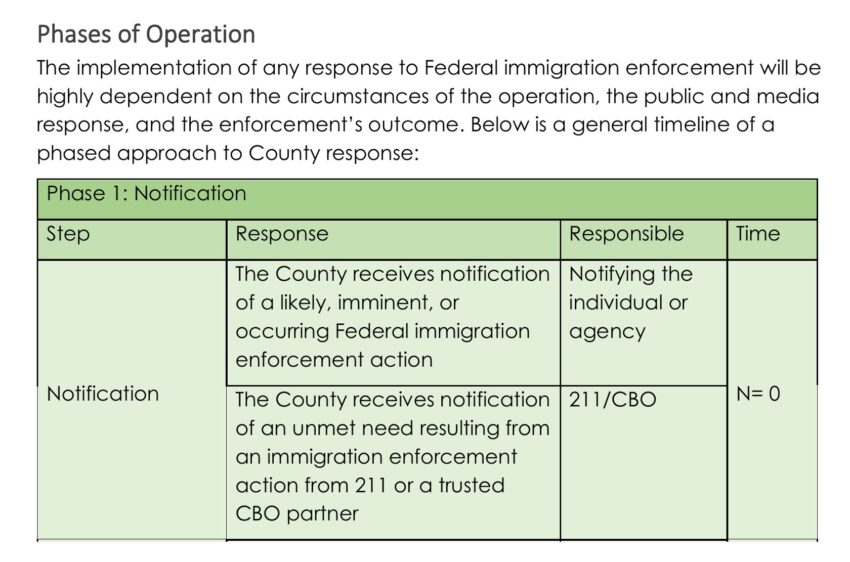
The plan is a 19-page “concept of operations” dated June 2026 and linked from the county’s immigrant support page.
Phase 1 is notification. Within an hour, whichever county department hears first must alert emergency management, the county administrator’s office and the Office of Equity. It must also alert the key departments in what the plan calls the Safety Net Collaborative: health services, human services, child support services and the public defender. The County Executive’s Office calls community groups such as the rapid response network. County communications starts “public messaging and rumor control,” and updates go around within two hours.
The plan limits what the county says in public: it “will not broadcast information about immigration enforcement actions.” Its public role is resources, county policy and correcting rumors.
What moves it to Phase 2
Phase 2 is the response. It starts when the emergency management department decides a trigger has been met. If the criteria are met, the department’s own operations center or the county Emergency Operations Center is to open within an hour. Help for separated families is to start within two hours and wider community support within 24 hours.
One set of triggers counts children. If four or fewer minors are separated from their caregivers, emergency management activates its department center. More than that brings in the full Emergency Operations Center. The plan sets that line at “five (5) or more” on one page and “more than five (5)” on the next. “Any situation of any size involving a minor being separated from their primary caregiver(s) will require a response from safety net partners,” the plan says. Child protective services handles children left without a parent. Adult Protective Services steps in for people 60 and older or with disabilities who lose a caregiver. Animal control picks up pets left behind.
The county may also open the full center if police can’t break up a protest, if a city asks for help, or if community groups report a large need that the county confirms.
The county’s Friday statement didn’t say whether the child the network reported left behind set off the plan’s response for separated children. County Executive David Guhin spoke with The Oak Leaf, Santa Rosa Junior College’s paper. He said the county set up a virtual emergency operations center Friday morning. In the plan, opening an operations center is a Phase 2 step.
The emergency Hopkins wants
Hopkins spoke at a rally outside the county administration building Friday evening, The Press Democrat reported. She said she had asked Guhin to declare a state of emergency. She wants it to free up money for immigrant families afraid to leave home for work, school or food aid.
“So we are looking at that as a potential option,” Guhin told The Oak Leaf.
The plan says the county executive “may proclaim a local emergency within the operational area to support actions or trigger points within this plan.” It also says “it is very unlikely” the county would get state or federal money back for the cost.
The county already has a way to put cash in people’s hands after a disaster. In February 2024 the Board of Supervisors approved contracts with two groups to hand out disaster cash: Community Organizations Active in Disasters and the Child Parent Institute. Each can give out up to $550,000. An eligible person gets $500 to $2,000. The program kicks in after “a qualified emergency event, activation of the Emergency Operations Center, or an emergency declaration by the Board of Supervisors.” The two groups then have 72 hours from being notified to start checking who qualifies. A household must earn 60% or less of area median income or be enrolled in a program such as Medicaid or CalFresh. The screening counts people who live in the county, had to evacuate, lost housing or can’t work because of the disaster. The contracts run through 2027.
Hopkins and Supervisor Rebecca Hermosillo served on the board’s immigrant-support committee. It looked at using that program after immigration arrests. The committee’s June 1 notes describe the program as “designed for use during a County disaster and proclaimed emergency.” The Office of Equity said families need cash, not rent help. On June 16, staff said it “could be leveraged during a large-scale immigration event.” The committee directed the county to use it. It also directed the county to consider changing the dollar amounts and how long benefits last when the program returns to the board in 2027. That was the committee’s last meeting.
Where to get help
The rapid response network’s 24-hour hotline, 707-800-4544, takes reports of enforcement and connects families with lawyers. Dial 211 for food, housing and legal referrals. The Redwood Empire Food Bank said anyone can send a trusted person to pick up groceries for them, KRCB reported.
Get the Gazette by email
The day’s stories from Sonoma, Napa, Lake and Mendocino counties, picked by the editor. Free.